


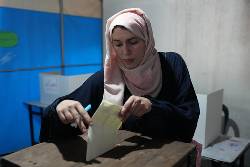
DEIR AL-BALAH, Gaza Strip (AP) — Palestinians lined up outside polls in tents and donated buildings to vote in the first elections held in part of Gaza in more than two decades.
More than 70,000 people are eligible to vote for municipal government in Deir al-Balah, a central Gaza city that has been damaged by airstrikes but was spared an Israeli ground invasion. The single-city vote is a largely symbolic “pilot," election officials say, part of an effort to politically link Gaza and the occupied West Bank. Palestinians see both as integral to any future path to statehood.
Voters spoke about the near-total absence of public services and said the devastation in Gaza compelled them to participate.
“I came to vote because I have a right to elect members to municipal council so they can provide us with services,” Ashraf Abu Dan said outside his Deir al-Balah polling place.
There and throughout the occupied West Bank, voting will determine the makeup of local councils tasked with overseeing water, roads and electricity. Turnout may reflect the level of public trust in a broader system led by aging leaders in the West Bank and as Gaza prepares for an anticipated transition from Hamas rule.
Some polling places in the West Bank and central Gaza's Deir al-Balah were busy on Saturday, though others were more empty. Election officials reported 24.5% turnout as of 1 p.m.
Voters who turned out said they wanted a say over decision-making in their cities.
“Municipal laws need to be enforced so people feel there’s justice,” Khalid al-Qawasmeh, a voter in the West Bank city of Beitunia, said outside his polling place in the West Bank city Beitunia. His finger was inked blue to mark having voted.
Linking the West Bank and Gaza politically
Though it has not held presidential or legislative elections since 2006, the Palestinian Authority promoted the local races after reforms it enacted last year in response to demands from international backers.
Under the slogan “We Stay,” the Ramallah-based Central Election Commission campaigned to encourage participation and reflect how Palestinians living amid war and occupation want a say in how they're governed.
“We’re talking about geographically linking the West Bank and Gaza Strip,” Rami Hamdallah, the commission's chairman, said.
With Gaza mostly decimated after more than two years of war, the commission chose to hold its first vote in Deir al-Balah but had to improvise because it was unable to conduct traditional voter registration.
Hamdallah said Israel blocked the entry of materials like ballot paper, ballot boxes or ink into Gaza. The commission repurposed material instead, using wooden ballot boxes and blue ink leftover from a vaccination drive last year.
The commission said it did not coordinate directly with either Israel or Hamas ahead of the vote. Associated Press footage showed security officers keeping order outside polling stations. COGAT, the Israeli military body that oversees humanitarian affairs in Gaza, did not respond to questions about blocking materials.
Though Palestinian voter turnout has gradually decreased, it has been relatively high in past local elections by regional standards, averaging between 50% and 60%. By comparison, turnout in recent local elections in Lebanon and Tunisia was under 40% and 12%, respectively.
A thin candidat
e pool
Ninety-year-old President Mahmoud Abbas signed a decree last year reforming elections in line with some demands of Western donors, including allow voting for individuals rather than slates.
In January, another Abbas decree required candidates to accept the program of the Palestine Liberation Organization, the group that leads the Palestinian Authority. The program calls for the recognition of Israel and renouncing armed struggle, effectively sidelining Hamas and other factions.
Campaign posters have been plastered across cities, though many — including Ramallah and Nablus — don't have contested elections.
Slates in major cities are dominated by Fatah, the faction that leads the Palestinian Authority, and independents, some with ties to other factions. However, it’s the first time in six local elections that no faction besides Fatah has put forward its own slate — an absence that analysts say reflects political disillusionment under Abbas and the authority’s aging leadership.
In Qalqilya, a city where no slates registered to participate at all, Marwan Ennabi said elections didn't reflect that Palestinian democracy was thriving. He said he expected more of the same from officials regardless of what happens in any city. The Palestinian Authority will appoint councils in cities without contested races.
“This isn't transparency," he said. "This is chaos, chaos, chaos!”
The Palestinian Authority’s power has withered amid years without peace negotiations and Israel tightening its grip on the occupied West Bank. But it sees local elections as a low-risk way to demonstrate progress on reforms, said Aref Jaffal, director of the al-Marsad Arab World Democracy and Electoral Monitor.
“The PA wants to show it is on the right track on political, financial and administrative reforms, and is using local elections as a symbol of that,” he said.
With the authority incapable of addressing hundreds of new military gates and settler outposts constricting movement in the West Bank, he said councils have taken on greater importance, overseeing local health centers and schools that residents once accessed elsewhere.
Deir al-Balah will be Gaza's first election since 2006
Hamas won parliamentary elections in 2006 and violently seized control of Gaza from the Fatah-led Palestinian Authority a year later. It did not put forward candidates Saturday.
Hamas controls the half of Gaza that Israel withdrew from last year, including Deir al-Balah, but the coastal enclave is preparing to transition to a new governance structure under U.S. President Donald Trump’s 20-point plan.
The plan established an international Board of Peace and a committee of unelected Palestinian experts supposed to operate and govern under it. Progress toward further phases, including disarming Hamas, reconstruction and transferring power, is stalled.
Though elections in Israeli-annexed East Jerusalem are regular points of contention between Israel and Palestinian leaders, the Oslo Accords did not include provisions about holding local races there.
___
Metz reported from Ramallah, West Bank. Associated Press writers Jalal Bwaitel and Imad Isseid in Ramallah, West Bank, contributed to this report.
...