


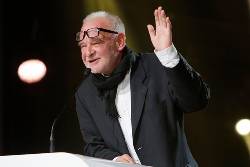
BUDAPEST, Hungary (AP) — The celebrated Hungarian filmmaker Béla Tarr, director of such works as “Sátántangó” and “The Turin Horse” and the recipient of numerous awards for his long and often darkly comic films, has died at 70.
During a career spanning decades, Tarr wrote and directed nine feature films, starting with his debut, “Family Nest,” in 1979 and ending in 2011 with “The Turin Horse,” which won the Silver Bear Jury Grand Prize at the Berlin International Film Festival that year.
Tarr frequently collaborated with Hungarian author László Krasznahorkai, who last year won the Nobel Prize in literature. Tarr's films, some of which were adaptations of Krasznahorkai's novels ("Sátántangó" and "Werckmeister Harmonies"), have been awarded prizes at festivals around Europe and Asia, and he received honorary professorships at universities in China.
In a statement on Tuesday, the Hungarian Filmmakers’ Association confirmed Tarr’s death, writing that “with deep sorrow we announce that, after a long and serious illness, film director Béla Tarr passed away early this morning.”
Tarr was born in 1955 in the southern Hungarian city of Pécs, but lived most of his life in the capital, Budapest. He completed his first feature film, “Family Nest,” when he was only 23. That film won the Grand Prize at the Mannheim-Heidelberg International Film Festival that year.
His films, the longest of which, “Sátántangó,” clocks in at 439 minutes or more than seven hours long, were widely praised as being beautifully shot while often using slow pacing and stark imagery to depict despair and social decay.
Often shot in black and white and defined by long, hypnotic single takes that could last upward of ten minutes, Tarr’s films depict bleak, hopeless, even dystopian landscapes set during Hungary's socialist era or in the years following the end of Soviet-dominated communism in Eastern Europe.
One of his most celebrated films, “Damnation” released in 1988, was co-written with Krasznahorkai and, after being positively received on the film festival circuit, helped to propel Tarr toward greater international recognition.
His unique style made his work a major influence on art house cinema including American filmmakers Gus van Sant and Jim Jarmusch, who have praised his vision.
Tarr worked closely with his editor and principal collaborator Ágnes Hranitzky for decades, and Hranitszky edited all of Tarr's films beginning with “The Outsider” in 1981. She also received co-directing credit alongside Tarr in his final three feature films, “Werckmeister Harmonies”, “The Man from London” and “The Turin Horse.”
Tarr was at times politically outspoken, and criticized nationalism and populist politicians such as Hungarian Prime Minister Viktor Orbán, as well as U.S. President Donald Trump and France's far-right leader Marine Le Pen.
He was also critical of Hungary's cultural policies under Orbán, and helped sponsor a group of students at the University of Theatre and Film Arts in Budapest who had occupied their campus in protest of government measures in 2020.
Following the release of his final feature film "The Turin Horse" in 2011, Tarr moved to the Bosnian capital of Sarajevo where he founded a film academy known as film.factory. From there, he produced numerous films by the academy's students, and split his time between Sarajevo and Budapest.
...