


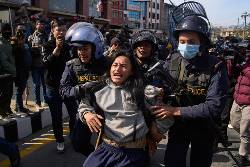
KATHMANDU, Nepal (AP) — Mukesh Awasti was all set to leave for Australia to pursue a degree in civil engineering on a sunny day in September, but instead he joined a youth revolt against corruption in Nepal and lost his leg after being shot by security forces.
Lying on a hospital bed at the National Trauma Center in the capital Kathmandu where his leg was amputated, 22-year-old Awasti said he regrets giving up so much for the little that has been achieved after the sacrifices of so many people.
Violent protests in Kathmandu that began Sept. 8 left 76 people dead and more than 2,300 injured before the demonstrations fueled by “Gen Z” activists forced the appointment on Sept. 12 of Nepal's first female prime minister, Sushila Karki, a retired Supreme Court judge who has promised fresh elections in March.
Since then, the interim government and its leader have come under criticism from many of the people who took part in the protests and expected major changes in the Himalayan nation.
“I am regretting my decision to take part in the protest because they have been zero achievement from the new government we brought which has failed us,” Awasti said. “There should be end to corruption which has not happened and the people who opened fire on the demonstrations should have been arrested but that that has also not happened either.”
So far the government's anti-graft agency has filed one significant corruption case that does not include key political figures. The politicians accused of corruption by protesters are preparing to contest upcoming elections and there has been no case filed against leaders who were in power when protesters were injured in September.
Demonstrators say promises have not been met
Dozens of demonstrators, including some who were injured in September, recently have protested against the government they brought to power. These protests outside the prime minister's office has been held in the past few weeks with police forced to break some of them.
“We are back here in the street because the government has failed to live up to their promise. There are so many families of those who lost their lives and many who were injured but what has the government done? Nothing," said Suman Bohara, who walks with crutches on a shattered right foot. "We are here because we are compelled to.”
Tens of thousands of mostly young demonstrators first gathered in Kathmandu on Sept. 8 to protest widespread corruption, lack of opportunities, employment and poor governance, which was triggered by a ban on social media. They broke through police barricades and attempted to enter parliament, only to be shot by security forces.
A day later, the protests spread across the country. Angry mobs burned down the offices of the prime minister and president, police stations and the homes of top politicians who were forced to flee on army helicopters. The army eventually stepped in to restore control and negotiations ended with Karki's appointment and the key task of conducting parliamentary elections.
The government has said it is determined to meet that goal.
“As the world is looking forward to a smooth change in government through our elections on March 5, I want to assure that we will deliver these elections,” Karki said. “Our preparations are almost complete, and the security environment has improved a lot with our security apparatus is assured enough.”
Gen Z groups show a lack of clarity
Different demands have emerged from separate groups among the young protesters including direct election of prime ministers, scrapping the present constitution and jailing all previous politicians. There is no single leader or group but rather several individuals who have claimed to represent Nepal’s voice in the Gen Z movement.
The lack of clarity among the protesters since September has been a key hurdle in Nepal, according to analysts.
“All the confusion right now in Nepal is because of the lack of clarity among the Gen Z groups on what they are demanding and how the government was formed,” said Abeeral Thapa, principal of Polygon College of Journalism and Mass Communications in Kathmandu.
Some are beginning to oppose the planned elections in March, saying their protest was not intended only to bring about elections for a new Parliament, while their demands to end corruption and arrest all the corrupt politicians should be fulfilled immediately.
Other groups seek elections that would bring new lawmakers who would perform all these tasks.
It has not been clear how powerful the government is and the limitations on a mandate to fulfill all the demands from the people who brought the interim leaders to office. When appointing the interim government, the president mentioned that the key purpose was to conduct elections for Parliament.
Thapa noted Nepal’s constitution does not have a specific provision for forming an interim government. A line in the document reads, “The main duty of the President shall be to abide and protect the constitution.”
“The protests were not well planned to begin with, they began with controlling corruption and end the ban on social media,” Thapa said. “But in reality what happened was like they had gone deer hunting but ended up killing a tiger, with the protest taking a major turn with the government collapsing.”
It remains doubtful the promised election in March can be held, but there are no alternatives to polls, Thapa said.
...