


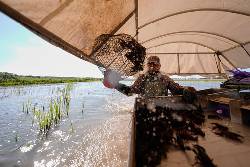
CROWLEY, La. (AP) — Spring is peak season in Louisiana for crawfish, the hard-shelled star of outdoor parties. But a shortage of foreign workers is dampening the mood.
Deep in Louisiana's bayous, where crawfish production is a $300 million industry that is a key ingredient for backyard boils and buttery etouffees served in New Orleans' French Quarter, operators are fuming over labor struggles and pointing fingers at President Donald Trump's administration over what they say has been a failure to authorize enough guest foreign workers.
The shortages add to a list of industries in the U.S. that rely on seasonal foreign labor, including landscaping and construction, whose struggle to fill jobs has been exacerbated during the Trump administration's wider clampdown on legal avenues for immigration. In Louisiana, the need for crawfish workers has strained an industry that is a symbol of state pride and frustrated Republican officeholders, many of whom broadly support Trump’s hard-line immigration agenda but say their pleas for more legal laborers have gone unanswered.
“People have built businesses around these workers and this year we can’t get them,” said Alan Lawson, who runs a crawfish production facility in the rural town of Crowley. “This industry would not exist without it because the American people don’t want to do the jobs we’re offering.”
Large-scale crawfish producers use guest workers, many from Mexico and Central America, to shell and freeze the freshwater catch that is often pulled from swampy rice fields. They are hired on H-2B visas for nonfarming jobs and are allowed to stay in the U.S. for less than a year after businesses first offer the jobs to Americans.
The Department of Homeland Security is required to release 66,000 H-2B visas each year and can release nearly double that amount. But that process happened later than usual this year — after Louisiana's crawfish season had already begun.
DHS did not respond to multiple requests for comment. The Department of Labor said it respects the crawfish industry and importance to the U.S. economy, and that the agency “has been actively engaging with industry stakeholders to help address workforce needs and identify workable solutions.”
But even if guest workers arrive before crawfish season ends around June, Lawson says, the damage is done. Restaurant owners and processors say crawfish prices could spike for consumers already struggling with affordability.
The demand for seasonal guest workers is high
U.S. businesses' increasing reliance on seasonal foreign workers to do grueling jobs predates the Trump administration. The federal government has not kept pace with the expanding need, and Trump's immigration crackdown also has impacted the labor market. Businesses are seeking tens of thousands more guest workers than the federal government has made available, according to Labor Department data.
“The demand is there but the supply is not,” Louisiana Farm Bureau Federation Public Policy Coordinator Andy Brown said. “These businesses want to follow the law. They want to go through the legal parameters to meet their labor needs.”
Most seasons at Lawson's facility, the job of peeling and packaging thousands of pounds of the sweet-tasting, bright red crustaceans is handled by more than 100 foreign workers. None have been allowed to come this season.
DHS can begin offering supplemental visas in consultation with the Labor Department at the start of the federal fiscal year in October. However, the Trump administration did not release supplemental visas until February. Initially, it capped them at 35,000, or roughly half what the Biden administration authorized. The Trump administration eventually agreed to release nearly 65,000 supplemental visas — on par with recent years — following pressure from businesses.
Crawfish producers say they don't have enough workers for the season
Louisiana officials say the federal government rejected many crawfish producers’ applications because they listed start dates before January. DHS told Lawson that his company was not eligible because he had applied months earlier, according to a February rejection notice he showed to The Associated Press.
At least 15 of the state’s 20 major crawfish processing plants have no guest workers this year, according to Louisiana Department of Agriculture and Forestry Commissioner Mike Strain. The Republican said the Trump administration’s indifference to their plight has been “unacceptable.”
Crawfish processors say that despite advertising locally for months for their peeling jobs, only a handful of Americans have turned up for seasonal gigs paying around $13 an hour.
“I can’t put the crawfish somewhere else. They have to be peeled at this time,” said processor David Savoy. “The locals don’t want to do it, I’ve tried — standing on concrete for seven, eight hours a day, peeling crawfish until your hands hurt.”
Some immigration law experts said the crawfish industry's labor shortage reflects the administration's attitude toward legal immigration.
“There’s much less of a push to facilitate legal immigration,” said Julia Gelatt, associate director of the U.S. Immigration Policy Program at the Migration Policy Institute. “It’s not a high priority to make sure that the immigration system is moving smoothly.”
Restaurants and crawfish lovers could lose out
Crawfish farmers will have fewer options to sell their products and the price of frozen tail meat in grocery stores will rise, processors warn.
Chandra Chifici, who owns the New Orleans seafood restaurant Deanie’s, is worried she won't be able to stockpile enough Louisiana crawfish to get through the monthslong offseason.
“Some companies might not be able to have some of their dishes on the menu,” Chifici said. “When tourists come into town, that’s what they’re here for.”
___
Brook reported from New Orleans.
___
Brook is a corps member for The Associated Press/Report for America Statehouse News Initiative. Report for America is a nonprofit national service program that places journalists in local newsrooms to report on undercovered issues.
...