


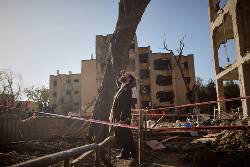
CAIRO (AP) — President Donald Trump has warned that the United States will “obliterate” power plants in Iran if the Islamic Republic doesn’t fully open the strategic Strait of Hormuz within 48 hours, and Iranian missiles struck two cities near Israel’s main nuclear research center, leaving dozens of people injured and shattered apartment buildings.
The developments signaled the war in the Middle East, now in its fourth week, was moving in a dangerous new direction.
Sirens blared across Israel on Sunday morning, warning of a new incoming barrage from Iran as residents woke up to scenes of vast damage in the southern cities of Dimona and Arad.
In Qatar, authorities said six people were confirmed killed in a Qatari helicopter crash in the Persian Gulf nation’s territorial waters the day before. The Interior Ministry said one person is still missing from the crash on Saturday, which was blamed on a “technical malfunction.” The statement didn’t clarify the nationality of the dead or say if they were civilian or military.
In his ultimatum, Trump said on Saturday he would give Iran 48 hours to open the vital waterway or face a new round of attacks. He said the U.S. would destroy “various POWER PLANTS, STARTING WITH THE BIGGEST ONE FIRST!”
He may have meant the Bushehr nuclear power plant, Iran's biggest, which was already hit last week, or Damavand, a natural gas plant near Tehran, Iran's capital.
In turn, Iran warned early Sunday that any strike on its energy facilities would prompt attacks on U.S. and Israeli energy and infrastructure assets — specifically information technology and desalination facilities — in the region, according to a statement citing an Iranian military spokesperson carried by state media and semiofficial outlets.
The Strait of Hormuz, which connects the Persian Gulf to the rest of the globe’s oceans, is a critical pathway for the world’s flow of oil. Attacks on commercial ships and threats of further strikes have stopped nearly all tankers from carrying oil, gas and other goods through the passage, leading to cuts in output from some of the world’s largest oil producers, because their crude has nowhere to go.
Seyed Ali Mousavi, Iran’s Permanent Representative to the International Maritime Organization, said in remarks carried by two Iranian news agencies that navigating the strait would be possible for “everyone except enemies” — indicating Tehran would determine which vessels are allowed passage. Iran has already approved the passage of ships through the waterway to China and elsewhere in Asia.
Iran strikes area near Israeli nuclear site
Israel’s military said it was not able to intercept missiles that hit Dimona and Arad, the largest near the Negev Desert nuclear center. It was the first time Iranian missiles penetrated Israel’s air defense systems in the area.
“If the Israeli regime is unable to intercept missiles in the heavily protected Dimona area, it is, operationally, a sign of entering a new phase of the battle,” Iran’s Parliament Speaker Mohammad Bagher Ghalibaf said on X.
Rescue workers said at least 64 people were taken to hospitals after the direct hit in Arad. Dimona is about 20 kilometers (12 miles) west of the nuclear research center and Arad around 35 kilometers (22 miles) north.
Israel’s hard-line national security minister, Itamar Ben-Gvir, visited the southern town of Arad on Sunday, saying that Israel is in a “historic battle” against Iran and that it must “continue until victory.”
Israel is believed to be the only Middle East nation with nuclear weapons, though its leaders refuse to confirm or deny their existence. The U.N. nuclear watchdog said on X it had not received reports of damage to the Israeli center or abnormal radiation levels.
Israel denies responsibility for attack on Natanz
The Iranian strikes in Israel came after Tehran’s main nuclear enrichment site at Natanz was hit earlier on Saturday. Israel denied responsibility and the Iranian judiciary’s official news agency, Mizan, said there was no leakage.
The International Atomic Energy Agency has said the bulk of Iran’s estimated 972 pounds (441 kilograms) of enriched uranium is elsewhere, beneath the rubble at its Isfahan facility. It said on X it was looking into the strike.
The Pentagon declined to comment on the strike on Natanz, which was also hit in the first week of the ongoing war and in the 12-day war last June. Russian Foreign Ministry spokesperson Maria Zakharova said such strikes posed a “real risk of catastrophic disaster throughout the Middle East.”
The U.S. and Israel have offered shifting rationales for the war, from hoping to foment an uprising that topples Iran’s leadership to eliminating its nuclear and missile programs and its support for armed proxies. There have been no signs of an uprising, while internet restrictions limit information from Iran.
The war’s effects are felt far beyond the Middle East, raising food and fuel prices.
So far in Iran, the death toll in the war has surpassed 1,500, the state broadcaster reported Saturday, citing the health ministry. In Israel, 15 people have been killed by Iranian missiles and four others have died in the occupied West Bank. At least 13 U.S. military members have been killed, along with well over a dozen civilians in Gulf nations.
And in Lebanon, Israeli strikes targeting the militant Hezbollah group, an Iranian ally, have killed more than 1,000 people and displaced more than 1 million, according to the Lebanese government.
___
Metz reported from Ramallah, West Bank, and Lidman from Tel Aviv, Israel. Associated Press writers Jill Lawless in London and Sam Mednick in Tel Aviv, Israel, contributed to this report.
...