


CORPUS CHRISTI, Texas (AP) — A former Uvalde police officer was acquitted Wednesday of charges that he failed in his duties to confront the gunman at Robb Elementary during the critical first minutes of one of the deadliest school shootings in U.S. history.
Jurors deliberated for more than seven hours before finding Adrian Gonzalez, 52, not guilty in the first trial over the hesitant law enforcement response to the 2022 attack, which killed 19 children and two teachers.
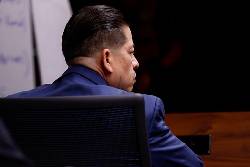
Gonzales appeared to close his eyes and take a deep breath as he stood to hear the verdict in a Corpus Christi courtroom hundreds of miles from Uvalde, where Gonzales' attorneys argued that he could not receive a fair trial. After the verdict was read, he hugged one of his lawyers and appeared to be fighting back tears.
“Thank you for the jury for considering all the evidence,” Gonzales told reporters. Asked if he wanted to say anything to the families, he declined.
Moments after the verdict was read, several members of families of the victims sat in silence, some crying or wiping away tears.
“Faith is fractured, but you never lose faith," said Jesse Rizo, whose 9-year-old niece Jackie Cazares was killed. He said he was frustrated by the verdict and hopes the state will press ahead with the trial of former Uvalde schools Police Chief Pete Arredondo, the only other officer who has been charged over the police response.
“Those children in the cemetery can’t speak for themselves,” Rizo said.
Arredondo’s trial has not yet been set.
Jurors declined to speak to reporters while leaving the courthouse.
The nearly three-week trial was a rare case in the U.S. of an officer facing criminal charges on accusations of failing to stop a crime and protect lives. Gonzales had faced the possibility of up to two years in prison if convicted.
The proceedings included emotional testimony from teachers who were shot and survived. Prosecutors argued that Gonzales abandoned his training and did nothing to stop or interrupt the teenage gunman before he entered the school.
“We’re expected to act differently when talking about a child that can’t defend themselves,” special prosecutor Bill Turner said during closing arguments Wednesday. “If you have a duty to act, you can’t stand by while a child is in imminent danger.”
At least 370 law enforcement officers rushed to the school, where 77 minutes passed before a tactical team finally entered the classroom to confront and kill the gunman. Gonzales was one of just two officers indicted, angering some victim’s relatives who said they wanted more to be held accountable.
Gonzales was charged with 29 counts of child abandonment and endangerment — each count representing the 19 students who were killed and 10 others who were injured.
During the trial jurors heard a medical examiner describe the fatal wounds to the children, some of whom were shot more than a dozen times. Several parents told of sending their children to school for an awards ceremony and the panic that ensued as the attack unfolded.
Gonzales’ lawyers said he arrived upon a chaotic scene of rifle shots echoing on school grounds and never saw the gunman before the attacker went inside the school. They also insisted that three other officers who arrived seconds later had a better chance to stop the gunman.
Gonzales’ attorney, Jason Goss, told jurors before they began deliberating that his client was not responsible for the attack.
“The monster that hurt those kids is dead,” Goss said. “It is one of the worst things that ever happened.”
A conviction would tell police they have to be “perfect” when responding to a crisis and could make them even more hesitant in the future, Goss said.
Some victims’ families made the long drive to watch Gonzales' trial. Early on the sister of one of the teachers killed was removed from the courtroom after an angry outburst following one officer’s testimony.
Gonzales’ trial was tightly focused on his actions in the early moments of the attack, but prosecutors also presented the graphic and emotional testimony as the result of police failures.
State and federal reviews of the shooting cited cascading problems in law enforcement training, communication, leadership and technology, and questioned why officers waited so long.
Prosecutors faced a high bar to win a conviction. Juries are often reluctant to convict law enforcement officers for inaction, as seen after the 2018 school massacre in Parkland, Florida. A sheriff’s deputy was acquitted after being charged with failing to confront the shooter in that attack — the first such prosecution in the U.S. for an on-campus shooting.
___
Vertuno reported from Austin, Texas.
...