


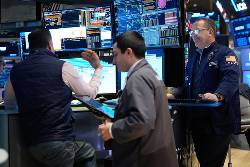
NEW YORK (AP) — Stocks are sinking Friday as hopes wither on Wall Street for a possible cut to interest rates by the Federal Reserve this year because of the war with Iran.
The S&P 500 fell 0.8% and was on track for a fourth straight losing week, its longest such streak in a year. The Dow Jones Industrial Average was down 228 points, or 0.5%, as of noon Eastern time, and the Nasdaq composite was 1.1% lower.
Stocks sank under the weight of leaping yields in the bond market. Higher yields will make mortgage rates and other borrowing more expensive for U.S. households and companies, slowing the economy, and grind down on prices for all kinds of investments. Treasury yields have been jumping since the war began because it could cause a long-term spike in oil and natural gas prices that drives up inflation.
Worries have gotten so high that traders have canceled nearly all their bets that the Federal Reserve could cut interest rates this year, according to data from CME Group. Some even think the Fed could raise rates in 2026, which was a nearly unthinkable scenario before the war began.
“I think it would be market shaking,” Ann Miletti, head of equity investments at Allspring Global Investments, said about rate hikes. But she also said that if oil prices stay high for a long time, they would likely drag so much on the economy that the Fed would not consider raising rates.
Lower interest rates would give the economy and investment prices a boost, and they're something President Donald Trump has angrily been calling for. Before the war with Iran, traders were betting heavily that the Fed would cut rates at least twice this year.
But lower rates risk also worsening inflation. And investors now see little room for central banks worldwide to cut interest rates to help their economies. Besides the Federal Reserve, central banks in Europe, Japan and the United Kingdom also held their interest rates steady this past week.
Friday's worries came as oil prices continued to swing. A barrel of Brent crude, the international standard, added 0.6% to $109.31 after erasing a dip from earlier in the morning. Benchmark U.S. crude rose 1% to $96.48 per barrel.
The price of Brent has zigzagged sharply on its way there from roughly $70 per barrel before the war began. Big swings have struck hour to hour as financial markets try to handicap how long the war will last and how much damage it will do to oil and gas production in the Persian Gulf.
The U.S. stock market has a history of bouncing back relatively quickly from past conflicts in the Middle East and elsewhere, as long as oil prices don't stay too high for too long. Oil prices aren't at a red-flag point yet, Miletti said, but “we're getting close if the duration is long enough.”
“If three months from now, we're in a similar situation, not only myself but a lot of other investors will be much more cautious,” she said. While companies can adjust to gradual rises in oil prices, Miletti said they're less able to quickly change their business models after a spike turns into a long-term new normal.
On Wall Street, Super Micro Computer dropped 27.2% and helped drag the U.S. stock market lower. The U.S. government accused a senior vice president of the company and two others affiliated with it of conspiring to smuggle billions of dollars of computer servers containing advanced Nvidia chips to China.
The company said it’s cooperated with the investigation and is not a defendant in the indictment. It placed its two accused employees on administrative leave and terminated its relationship with an accused contractor.
On the winning side of Wall Street was FedEx, which rose 1.6% after delivering a much stronger profit for the latest quarter than analysts expected.
In the bond market, the yield on the 10-year Treasury jumped to 4.36% from 4.25% late Thursday and from just 3.97% before the war started. That's a significant move for the bond market.
The two-year Treasury yield, which more closely tracks expectations for what the Fed will do, leaped to 3.88% from 3.79% late Thursday and is near its highest level since the summer.
Outside of Wall Street, indexes fell in Europe following their wipeouts on Thursday. Indexes also sank in China, though South Korea’s Kospi added 0.3%.
___
AP Business Writers Chan Ho-him and Matt Ott contributed.
...