


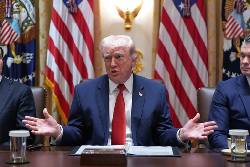
U.S. President Donald Trump said Thursday he will delay a threatened strike on Iran’s energy infrastructure and extend his deadline for Tehran to reopen the Strait of Hormuz until April 6, saying talks to end the war are “going very well.”
The move marks a pullback from Trump’s earlier warning that the U.S. would target Iran’s energy plants if the crucial shipping lane remained closed. Iran has threatened to retaliate against regional infrastructure, including desalination facilities, if the U.S. follows through.
A day after Tehran dismissed Trump’s 15-point ceasefire plan, the president said Iran was “begging to make a deal” and urged its leaders to “get serious soon” about negotiations.
Trump’s announcement on social media came after U.S. stocks fell sharply and oil prices rose, as doubt took over again on Wall Street about a possible end to the war.
The war has killed more than 1,900 people in Iran and nearly 1,100 in Lebanon, 22 Israelis and 13 U.S. military members, as well as a number of civilians on land and sea in the Gulf region. Millions of people in Lebanon and Iran have been displaced.
Here is the latest:
Trump delays threat to obliterate Iran’s energy plants until April 6
Trump said Thursday he’ll extend his deadline for Iran to open the Strait of Hormuz until April 6, pulling back on his earlier threat to bomb Iran’s energy plants if Tehran didn’t open the critical waterway.
Iran had threatened to retaliate against the region’s vital infrastructure, like desalination facilities, if Trump followed through.
Trump said he was holding off on carrying through his threat because talks aimed at ending the conflict are going “very well.”
Israel’s military says it is short thousands of troops as it fights on multiple fronts
Brig. Gen. Effie Defrin, an Israeli military spokesperson, said Thursday that the army needs about 15,000 soldiers, roughly half of them combat troops, to be at full strength for its multiple missions.
Israel can call up tens of thousands of reservists, but repeated deployments have prompted past pushback, with many citing exhaustion and the financial strain of leaving work and family behind.
With tens of thousands still deployed in Gaza and more sent to Lebanon, Defrin said Israel expected to broaden operations on several fronts. Defrin also pointed to the occupied West Bank.
Lt. Gen. Eyal Zamir, the military’s chief of staff, warned last week that the army should not have to divert forces to the West Bank during a multi-front war to contend with attacks by Israeli settlers on Palestinians and unauthorized outposts in military-controlled zones.
Wall Street has its worst day since the war with Iran started and crude oil prices rise
Doubt has taken over again on Wall Street about a possible end to the conflict.
The S&P 500 fell 1.7% Thursday. The index is headed for a fifth straight losing week, which would be the longest such losing streak in almost four years. The Dow Jones Industrial Average dropped 1%, and the Nasdaq composite sank 2.4%.
They’re the latest flip-flops for financial markets this week after Iran rejected a U.S. offer for a ceasefire. Oil prices rose more than 4%, and Treasury yields climbed in the bond market.
▶ Read more
UN food and agriculture agency’s top economist warns of serious impact if Iran war lasts 3-6 months
Maximo Torero said markets will absorb the Iran war’s impact if the conflict ends in the next two weeks or so. But if it continues for three to six months it will not only impact food security and energy but other sectors as well because prices will rise.
And those rising prices, and the fall in remittances from overseas workers, will affect economic development and growth across the globe, the chief economist for the U.N. Food and Agriculture Organization told a U.N. press conference Thursday.
He said an El Nino climate phenomenon, which tends to increase global temperatures, is also expected soon. A strong El Nino could significantly exacerbate the economic situation, he said.
“My message is, we need to find a way to resolve this problem as soon as possible,” Torero said in the video press conference. “Because, if not, the consequences … could be very dramatic, even worse that what happened in the Ukraine war.”
Experts see ‘different shades’ of Israeli control in southern Lebanon
“The first line of borders is a no-man zone. This is basically a large parking lot that is facing Israel,” said Mohanad Hage Ali, a senior fellow at the Carnegie Middle East think tank in Beirut.
“There is nothing there, no movement, nothing at all,” he said.
Lebanese movement is restricted farther north. During last year’s olive harvest, farmers struggled to reach groves because of Israeli strikes and had to be accompanied by Lebanese troops and U.N. peacekeepers, who coordinated with Israel.
Sarit Zehavi, the founder and president of the Alma Institute and a retired Israeli military officer, said Israel will likely establish a more extensive area of control stretching farther north.
She acknowledged that Israel was unlikely to defeat Hezbollah and was at risk of having to maintain a long-term presence in southern Lebanon.
“But the other alternative is to take the risk that we will be slaughtered. It’s as simple as that,” she said.
Israel invaded southern Lebanon in 1982 during the country’s civil war. Hezbollah, established that year, waged a guerrilla campaign that eventually ended the Israeli occupation in 2000.
Lebanon fears another occupation as Israel threatens to use Gaza tactics
As Israel’s leaders hint at a long-term occupation of southern Lebanon modeled on the devastating conquest of much of Gaza, many Lebanese who fled their homes are in limbo.
Some fear they may never return.
Elias Konsol and his neighbors fled the Christian border village of Alma al-Shaab with U.N. peacekeepers’ help. He was reunited with his mother, who cried in his arms, at a church near Beirut where funeral services were being held for a resident killed in an Israeli strike.
Konsol said there were no weapons or Hezbollah fighters in his village, but it was forced to evacuate anyway.
“We no longer know our fate,” he said. “We don’t know if we will see our homes and village again.”
▶ Read more
US inflation projected to reach 4.2% this year
The Iran war’s disruption of oil exports from the Middle East will substantially boost consumer prices while also slowing growth in the United States and many other developed countries, the Paris-based Organization for Economic Cooperation and Development said Thursday.
The OECD expects U.S. inflation to jump to an annual average of 4.2% this year, from about 2.6% in 2025. The increase will manly be driven by spiking gas costs, but fertilizer exports have also been interrupted and could raise food prices in coming months, the OECD said.
“In the United States, the impact of higher energy prices on inflation will more than offset the effect from the decline in effective tariff rates on imports,” the OECD’s interim outlook report said.
Growth is expected to slip to 2% this year from 2.1% in 2025, then decline further next year to 1.7%. In 20 of the largest countries, referred to as the Group of 20, which includes Japan, Europe, and large emerging economies such as Brazil, inflation is forecast to rise to 4% from 3.4%.
Renewables-rich Spain cuts fuel tax to soften energy blow caused by Iran war
Even though Spain generated over half its electricity last year from renewable sources, its government is still concerned that a global scarcity of oil and natural gas coming from the Middle East will impact consumers with higher prices at the pump.
So parliament has approved a package of emergency economic measures, including slashing the sales tax on gas and electricity bills from 21% to 10%. The government estimates that car owners will save 30 cents on the euro for every liter of gas, or around 20 euros per tank.
Truck drivers, farmers, herders and fishermen will be able to claim refunds of 20 cents per each liter for diesel from the government. The same refund will apply to fertilizers. Spain is also freezing the price of butane and propane.
The government says the measures total 5 billion euros ($5.7 billion) and will help 20 million of Spain’s 49 million residents.
Israel adds an armored division to its invasion of southern Lebanon
The 162nd Division’s deployment is the latest expansion of Israel’s ground offensive against Hezbollah, as senior officials say the army aims to control territory up to the Litani River.
Israel does not disclose division sizes but previously described three divisions in Gaza as “tens of thousands” of troops.
The move comes a day after Israeli Defense Minister Israel Katz said the country would expand its control and establish a “security zone” up to the Litani River. He drew parallels to Gaza, where many areas have been depopulated.
The Israeli military has destroyed bridges and homes in southern Lebanon and set up new positions in recent weeks. Lebanon says over 1 million people have been displaced and more than 1,000 people killed.
France says 35 countries joined military talks on reopening Hormuz shipping
Thursday’s videoconference of defense staff chiefs focused on how to reopen shipping “once the intensity of hostilities has sufficiently decreased,” France’s Defense Ministry said.
That could entail a “strictly defensive” mission to escort commercial vessels and restore freedom of navigation, the ministry said.
Power outages in some areas of Tehran
Witnesses told The Associated Press that power is out in some areas of the Iranian capital, although no official reports have been released yet.
Less than an hour ago, witnesses reported the sounds of heavy strikes and fighter jets overhead.
Witnesses report more heavy strikes in Tehran
They also said they heard the sounds of what appeared to be fighter jets flying overhead.
Trump Cabinet meeting stays mainly focused on Iran war
Trump’s first Cabinet meeting since the start of the Iran war ran an hour and 40 minutes. But unlike past meetings of this kind, the president kept it largely focused on the war.
Trump usually gives every Cabinet member time to speak, but on Thursday he limited speakers to himself, Vance, Rubio, Hegseth, Bessent, Energy Secretary Chris Wright and Interior Secretary Doug Burgum.
Still, Trump weighed in on a few unrelated topics, such as his choice of writing implements, a construction project at the Federal Reserve that he thinks costs too much, and lawsuits pending to stop him from closing the Kennedy Center performing arts venue for a two-year renovation project.
Trump sidesteps question about his deadline for Iran to open Strait of Hormuz
Asked whether he’s sticking to a five-day delay he announced on Monday, Trump said “I don’t know.”
Speaking at a Cabinet meeting, the president said it depends on whether his team tells him talks with Iran are “going along” or not.
“We have a lot of time,” Trump said. “It’s a day. In Trump time, a day- you know what it is? That’s an eternity.”
Trump threatened to strike Iranian power plants starting Monday unless the strait was fully reopened. He said the deadline was pushed back to negotiate a deal.
Israeli strikes in Lebanon kill another 22 people and wound 110 in the past 24 hours
The total number of people killed by Israeli strikes in Lebanon since the outbreak of the latest Israel-Hezbollah war has risen to 1,116, with 3,229 wounded, Lebanon’s health ministry said Thursday.
The death toll includes 121 children and 83 women. More than 1 million people have been displaced in Lebanon by the conflict.
The Iran-backed Lebanese militant group Hezbollah fired missiles across the border into Israel on March 2, two days after the U.S. and Israel attacked Iran. Israel has since launched widespread airstrikes and a ground invasion of Lebanon.
Missile fire from Lebanon killed an Israeli man in a city on the northern coast
Israel’s Magen David Adom emergency service says a man in his 30s was killed by shrapnel from a missile strike in Nahariya following a barrage from Lebanon.
It said medics treated a man in his 50s who was in moderate to serious condition, and three people who were lightly wounded.
Ukraine’s president arrives in Saudi Arabia after offering anti-drone help
President Volodymyr Zelenskyy is in Saudi Arabia on an unannounced visit, days after revealing that Ukraine is helping five countries in the Middle East counter attacks on their territory by drones amid the Iran war.
Ukraine has grown into one of the world’s leading producers of cutting-edge, battle-tested drone interceptors that are cheap and effective.
“Arrived in Saudi Arabia. Important meetings are scheduled,” the Ukrainian leader said on X Thursday along with video of his arrival. “We appreciate the support and support those who are ready to work with us to ensure security.”
Zelenskyy said last week that Ukrainian officials are helping Saudi Arabia, the United Arab Emirates, Qatar, Kuwait and Jordan with drone expertise and helping build a defense system.
Trump says US ‘doesn’t need the Hormuz Strait’
Asked by a reporter how close he was to marshaling a coalition of partners to help protect tankers moving through the strait, Trump said the U.S. has “so much oil — our country is not affected by this.”
The narrow waterway typically sees a fifth of the world’s oil exit the Persian Gulf through it to reach customers worldwide, particularly in Asia, and blockages there have sent oil prices near $120 per barrel at times.
And although it’s true that the United States doesn’t get a massive percentage of its oil from resources moving through the strait, the price of oil is set on the global market.
Iran’s stranglehold on the waterway has raised prices at the pump for drivers the world over. The nationwide average price of gas is up more than a dollar from just a month earlier.
Trump is not ready to seek suspension of federal gas tax to help ease prices at the pump
Asked by a reporter about that option during the Cabinet meeting, Trump said, “we’ve thought about it, I guess” and suggested that states suspend their taxes on fuel.
He segued into talking about the stock market and was asked again about the possibility of suspending the federal gas tax, which is 18.4 cents per gallon on gasoline and 24.4 cents per gallon on diesel fuel. That does not include state taxes, which often are higher.
Trump cannot suspend the federal tax on his own; Congress would have to approve.
But he indicated he wasn’t ready to go that route at the federal level at this time.
“It’s something we have in our pocket if we think it’s necessary,” Trump said.
Trump calls the German president’s condemnation of his actions in Iran ‘inappropriate’
In a speech on Tuesday, German President Frank-Walter Steinmeier said Trump’s aggression against Iran was a “dangerous mistake” in violation of international law.
Taking questions from reporters during Thursday’s Cabinet meeting, Trump likened Steinmeier’s statement to the U.S. assistance to Ukraine in its war with Russia, which he said was “not our war, we helped, but Ukraine’s done well.”
Trump, who as he campaigned for a second term said repeatedly he could swiftly end the Russia-Ukraine war, added, “if I can solve that, it will be a great honor to do it. I wish it could have gone faster.”
Trump claims Iran allowing Pakistan-flagged tankers through strait in sign of good faith for talks
Trump earlier this week cryptically said that Iran “gave us a present.” He revealed the gift during Thursday’s Cabinet meeting.
Trump said that Iranian officials, with whom the U.S. is engaging in back-channel talks, are allowing “eight boats of oil” to pass through the Strait of Hormuz, suggesting it was an apparent act of good faith for negotiations.
“Well, I guess we’re dealing with the right people,” said Trump, who indicated the tankers are operating under Pakistani flags.
Israeli military says it has sent another division into Lebanon, expanding its operation against Hezbollah
The announcement comes a day after Prime Minister Benjamin Netanyahu said Israel is expanding an area it controls along southern Lebanon’s border with Israel, as Israeli troops push through more villages in the area and fight with Iran-allied Hezbollah militants.
Israel has moved several thousand troops into southern Lebanon in recent weeks in what it says is a defensive move to protect its northern border communities from Hezbollah rocket and drone fire.
Israel occupied southern Lebanon from 1982 until 2000. Hezbollah was formed in the 1980s as a guerrilla force fighting that occupation.
Sirens in Israel
Sirens sounded across central Israel and Jerusalem after the military reported a missile launch from Iran.
Senior Hezbollah official condemns Lebanese government’s decision to expel Iranian ambassador
Mahmoud Qamati made the remarks at a protest beside Iran’s Embassy in the southern suburbs of Beirut, where dozens of people gathered waving Hezbollah and Iranian flags.
“Ambassador (Mohammad Reza) Sheibani, the ambassador to the Islamic Republic of Iran, will stay in Lebanon and will not leave Lebanon no matter how much you try,” Qamati said in a speech, condemning Lebanese Foreign Minister Youssef Rajji, a staunch opponent of Hezbollah, who made the decision to order the diplomat to leave.
“Don’t play with fire, because this fire will burn you, your people, and those behind you,” Qamati said.
Hezbollah is Iran’s key ally in Lebanon, and since the group’s inception in 1982 it has relied heavily on Tehran for weapons and financial support.
Bessent says Strait of Hormuz not a ‘choke point’ and that tanker ship traffic will increase
U.S. Treasury Secretary Scott Bessent said that Iran, by restricting oil and natural gas shipped through the Strait of Hormuz, is “trying to take control of the global economy through a choke point that we believe does not exist.”
Bessent’s phrasing was misleading, as the Strait of Hormuz is critical for global shipments of oil and natural gas, especially for Asia, and energy prices have increased since the war with Iran began.
Still, Bessent said that more tankers are making it through the Strait of Hormuz.
“I am confident that shipping traffic will continue to increase on a daily basis, even before we secure” the strait, Bessent said.
Explosions boom in Tehran
Witnesses heard repeated explosions across most parts of Iran’s capital, along with the activation of air defense systems. Very large blasts are also being reported.
Trump’s son-in-law says US negotiators ignore Iranians’ public statements
Speaking at a Saudi investment summit in Florida, Jared Kushner on Thursday echoed sentiments made by his negotiating partner Steve Witkoff in dismissing Iranians’ public statements, saying it’s often different than what is being communicated behind closed doors.
“The one thing with the Iranians, and we’re seeing this even now, is you have to ... just ignore a lot of what they say publicly, because I think that their statements are usually more for their domestic audiences,” Kushner, who has been volunteering as a U.S. peace envoy, told the audience at a Future Investment Initiative summit in Miami.
His comments came shortly before Witkoff spoke at Trump’s Cabinet meeting, where he said that despite Iranians assertions that there is no communication with Washington during the ongoing war, the U.S. has presented a 15-point “action list” where there is a “possibility” for a deal between the longtime adversaries.
Did Rubio do a Chuck D callback while talking about Iran?
Secretary of State Marco Rubio is a noted fan of 1990s rap.
During Thursday’s Cabinet meeting, his remarks appeared to borrow a bit from Public Enemy’s “Welcome to the Terrordome.”
Chuck D raps in the track off of the eponymous album “Fear of a Black Planet,” “I got so much trouble on my mind/ I refuse to lose/Here’s your ticket/Hear the drummer get wicked/The crew to you to push the back to Black.”
Rubio, Trump’s chief diplomat, offered, “But every day the Department of War lets the drummer get wicked over every portion of Iran that has these military capabilities, and the results are going to bear fruit for the world,” Rubio said.
Iran is ready for ‘any scenario’, ambassador says
The top Iranian envoy to U.N. institutions in Geneva has warned in an interview that any attempt by Israel and the United States to mount a ground invasion of Iran would be a “big” mistake.
Ali Bahreini says Iran is winning the war, and has forced the U.S. and Israel to back off their initial goals. He says those have now been reduced to trying to keep the Strait of Hormuz open for shipments to countries dependent on oil from the Persian Gulf.
Bahreini also says Iran’s supreme leader, Ayatollah Mojtaba Khamenei, is “safe” and running the country. Khamenei has not been seen or directly heard from since he was named to replace his slain father, Ayatollah Ali Khamenei.
Asked why Khamenei hasn’t been seen, the ambassador cited “security arrangements which are very necessary for this particular time.”
Hegseth says Iran conflict will be part of Trump’s legacy
“This is stuff for the history books; This is stuff for legacy,” the U.S. defense secretary said during a Cabinet meeting Thursday.
As part of his praise for the decision to engage in the conflict, Hegseth claimed that Iran had “a modern military” but that “never in recorded history has a nation’s military been so quickly and so effectively neutralized.”
Hegseth says Iran war is ‘unlike Iraq’
The U.S. defense secretary said Thursday that the war in Iran is “unlike Iraq. This isn’t a tie. This is not parity. This is not chaos. This is success. Pure American success.”
Hegseth spoke as he sat next to Trump at a Cabinet meeting. Hegseth noted that the war’s objectives “remain clear: No nukes, no navy, and complete dismantling of their missile program and defense industrial base.”
Trump noted that the Strait of Hormuz, through which 20% of the world’s oil normally flows, remained effectively closed because of the war, although the president predicted the waterway will open up.
...