


NEW YORK (AP) — Families and supporters of Americans detained in Iran say their loved ones face new dangers during the intensifying war, including the risk of becoming unintended casualties of Israeli and American bombardment or victims of retaliation from Iran’s repressive regime.
“For Americans imprisoned in Iran, this is about as terrifying a moment as it gets,” said Siamak Namazi, an Iranian American who was detained for nearly eight years before being released as part of a deal with the U.S. in 2023. “What these families are facing now is days of war with no clear end in sight.”
The U.S. government would not confirm how many Americans are being held in Iran, but the James W. Foley Legacy Foundation, a hostage advocacy organization, said there are six and that they face “unprecedented danger” because of the military conflict.
The known cases include a reporter formerly based in Washington and a Jewish Iranian American from New York who traveled to Iran last year for family reasons and hasn't been permitted to return to the U.S.
At least two of the known detainees are housed in Evin Prison, the notorious Tehran penitentiary where Namazi was held, according to representatives for the individuals. The high-security facility holds many of the Islamic Republic’s political prisoners and has been the target of past Israeli bombardment.
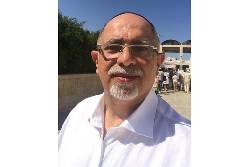
Kamran Hekmati, a 61-year-old from Long Island detained at Evin, spoke with his wife on Monday, a few days into the war, to assure her that he was safe for now, according to Shohreh Nowfar, his cousin.
But the family worries his condition could quickly deteriorate because he hasn’t been receiving regular treatments for his bladder cancer in the months since he was detained, she said.
“It’s an uncertain time in an uncertain country,” said Nowfar, a Los Angeles resident.
Trump administration calls for detainees' release
Ryan Fayhee, a lawyer for Reza Valizadeh, an Iranian American reporter also detained at Evin, said he's stressed the urgency of the moment in his regular talks with White House and State Department officials.
Israel’s military has taken to social media in recent days to warn residents living near the prison that they should evacuate amid the continuing airstrikes. The families of other foreign nationals imprisoned at Evin have told European news outlets that bombs have been hitting close enough to the detention center to blow out windows.
“It’s my job to let the administration and the Israeli government know that there are innocent American citizens within that prison,” Fayhee said. “They should take great care with this military action to avoid any unfortunate collateral damage.”
White House and State Department officials declined to respond to specific questions about the status of the detainees out of concern for their safety and security, but called on Iran to immediately release them.
“President Trump has been clear that he wants every American wrongfully detained to be returned home safe and sound, and that there will be dire consequences for regimes who treat Americans as political pawns,” said Anna Kelly, a White House spokesperson.
Valizadeh is among at least 15 reporters currently jailed in Iran, according to the Committee to Protect Journalists.
The 50-year-old fled the country in 2009 after reporting on its pro-democracy protests, according to a petition his lawyers submitted to the United Nations in January.
Valizadeh obtained U.S. citizenship in 2022 while working in Washington for Radio Farda, the Persian-language arm of Radio Free Europe, which receives U.S. government funding.
He was detained in 2024 after returning to Iran to visit his elderly parents and sentenced to 10 years in prison on charges that he was collaborating with the U.S. government.
The U.S. has since officially designated Valizadeh as wrongfully detained, meaning it believes him to be innocent and has assigned the case to the State Department’s special presidential envoy for hostage affairs, the government’s chief hostage negotiator.
Americans imprisoned on dubious charges
Among the other Americans whose plight has become public is Afarin Mohajer, a California resident originally from Iran.
She was detained in September and charged with posting propaganda critical of the Islamic Republic on social media and insulting its Supreme Leader and Islam, according to her son Reza Zarrabi, a political activist who lives in Germany.
Zarrabi didn’t immediately respond to messages seeking comment this week, but he has told European media outlets that his mother isn’t politically active and that he believes she was arrested to silence his outspoken opposition to the regime.
Hekmati’s family, meanwhile, is convinced the New York City jewelry business owner is just the latest victim of Iran’s “hostage diplomacy.”
The country for decades has detained Americans in the hopes of securing the release of Iranians locked up in the U.S. or exacting concessions from Washington. Just last week, the U.S. sought to impose costs on Iran for hostage-taking, with the State Department a day before the conflict began designating the country as a state sponsor of wrongful detention.
Nowfar said her cousin, Hekmati, left Iran after the 1979 revolution but has returned several times without issue.
Then in May, Iranian authorities stopped him at the airport, seized his passport and forbade him from leaving the country. He was eventually charged under an Iranian law that makes it illegal to have visited Israel within the past 10 years.
Hekmati’s family maintains that his last trip to Israel was some 13 years ago for his son’s Bar Mitzvah. They also dispute espionage-related charges that accuse him of having met with Mossad agents.
“They just wanted to have a hostage. An American hostage," Nowfar said.
There are also concerns that Hekmati's faith exposes him to further mistreatment, says Kieran Ramsey, the chief investigative officer at Global Reach, a nonprofit working on Hekmati’s case.
“He’s not only American, he's also Jewish — and we had had some concerns early on in this case of him” getting bullied, said Ramsey, who previously led the U.S. government’s Hostage Recovery Fusion Cell.
As for Namazi, he sympathizes with families seeking solace, recalling a chaotic 2022 fire that killed at least eight inmates during his time at Evin.
“I remember the smoke, the confusion, and the total absence of reliable information,” the 54-year-old Washington resident said. “For us prisoners it was terrifying. My mother says that night was one of the hardest she endured.”
___
Tucker reported from Washington.
___
Follow Philip Marcelo at https://x.com/philmarcelo
...