


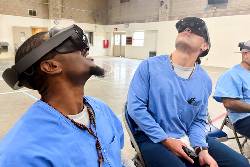
CHOWCHILLA, Calif. (AP) — Jacob Smith has been in prison for two decades but he and other inmates are still taking regular trips to far-flung, exotic locales. No passport required, just a virtual reality headset.
“I went to Thailand, man!” Smith recalled with a grin, describing the first time he strapped on a VR device and was transported to the lush landscapes and bustling markets of Southeast Asia.
A Los Angeles-based nonprofit is bringing the technology to California prisons with the goal of providing inmates a brief escape and, more importantly, exposure to real world scenarios that will prepare them to reenter society.
During a weeklong program last month, incarcerated men at Valley State Prison near Fresno sat on metal folding chairs in a common area. They shuffled in their seats as they were outfitted with the headsets that resemble opaque goggles. Their necks contorted slightly and smiles spread across their faces as the high-definition videos started and their journeys commenced.
Some saw the sights on the other side of the globe, including Bangkok, while others experienced more practical scenes, such as job interviews. The men sit across virtual desks from virtual interviewers who are both easygoing and hard-nosed to give them the tools for finding employment once they're released.
“For a lot of us, the workforce has changed and things are different with the application process,” said Smith, who is eligible for parole in 2031 and now volunteers helping his fellow inmates navigate the VR experience. “It’s a nerve wracking experience going to sit in front of somebody and telling them why I’m good for the job.”
Afterward, volunteers help the inmates process the emotions or traumas that bubbled up during their experiences. Sabra Williams, founder of the nonprofit Creative Acts, calls the VR devices a “hope machine.”
The program stems from a prison arts project that Williams ran that incorporated theater, music, poetry, dance and painting. Watching incarcerated people become engaged in artistic pursuits made her wonder about other ways to “bring the outside world inside."
She heard from people who had left prison lamenting that technology had passed them by. They felt confounded by simple things like pumping gas, checking out at a supermarket, or going to the ATM.
“And what I hear from them is that it made them feel like they didn’t belong, and that they only belong in prison,” she said.
First Williams' group dug for footage on YouTube to recreate everyday activities. Soon they were creating their own videos focusing on travel, constructive scenarios, civic engagement, conflict resolution, art, and even meditation “to blow their minds and also educate their minds.”
Such technology could have an important role to play in rehabilitation and, especially, reintegration into society, said Nancy La Vigne, the dean of Rutgers-Newark School of Criminal Justice in New Jersey. She envisions people who haven't been in the real world for a long time using VR to act out navigating the DMV or figuring out how to take a city bus.
Another benefit could be a calming effect on stressed out inmates. La Vigne points to research published by the American Psychological Association that found that incarcerated people who viewed short nature videos showed reduced levels of aggression and were subject to fewer discipline reports.
But with a hefty price tag and limited access, La Vigne worries about the “practical realities," such as unintended consequences that stem from those who might be left out of the VR experience.
“You can't just hand them out or sell them at commissary,” La Vigne said.
A former inmate, Richard Richard, first used a VR headset about six years ago when the program was launched and since his release has become a volunteer for Creative Acts. He said he's impressed by how far the technology has advanced. He loves watching his fellow inmates use the devices for the first time and then progress as they deal with trauma and emotional issues.
“You may physically be here, but mentally, spiritually you can actually transcend this environment,” he said.
The group conducts the program, using 100 Oculus headsets donated by Meta, both in general population and in solitary confinement. Youth offenders are also eligible. It currently runs three times a year at four California prisons, and Williams hopes to expand it throughout the state and across the country.
The California Department of Corrections and Rehabilitation didn't immediately respond this week to inquiries about plans to expand the program. But in announcing the introduction of VR at the California Men's Colony prison in San Luis Obispo County last August, the department said the usage has the potential “to heal trauma, regulate emotional response, and prepare for a safe, successful reentry into society.”
The introductory two-minute trip to Thailand is often emotional for many inmates, some of whom had “never been off their block, let alone out the country,” Williams said.
“And so many times people would take off the headsets and they’d be crying," she said. "Because they’d be like, ‘I never knew the world was so beautiful.’”
___ Weber reported from Los Angeles.
...