


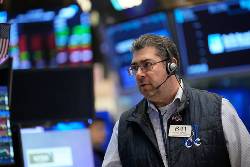
NEW YORK (AP) — The U.S. stock market is swinging between losses and gains Tuesday as uncertainty continues about how long the war with Iran will last.
The S&P 500 initially dropped 0.8% in the morning and erased much of its surge from Monday. But it trimmed that loss by afternoon trading and was down 0.2%, as of 1:59 p.m. Eastern time. The Dow Jones Industrial Average rose 11 points, or less than 0.1%, while the Nasdaq composite fell 0.7%.
Markets have been on a roller coaster since President Donald Trump raised hopes that the war with Iran could end soon when he said Monday that the United States and Iran held productive talks “regarding a complete and total resolution of our hostilities in the Middle East.” His announcement, which came just before Wall Street opened for trading, caused financial markets worldwide to flip immediately.
It calmed worries that the war may cause a long-term disruption to the oil and natural gas industry in the Persian Gulf, one big enough to send a blast of inflation to the region’s customers worldwide.
But the market got both encouraging and discouraging signals about the war on Tuesday. On one side, attacks continued in the Middle East after Iran denied having direct talks with the United States. On the other, Pakistan’s Prime Minister Shehbaz Sharif wrote on X that his country is ready to “facilitate meaningful and conclusive talks” to end the Iran war.
After all that, the price for a barrel of Brent crude oil rose 4.8% to $104.71, a day after slumping more than 10%. Benchmark U.S. crude rose 4.8% to $92.96 per barrel and clawed back some of its own 10.3% plunge from the day before.
In the bond market, Treasury yields returned to rising and upped the pressure on financial markets worldwide. Higher yields make mortgages and other kinds of borrowing more expensive for households and for businesses, which slows the economy. They also hurt prices for all kinds of investments, from stocks to gold to cryptocurrencies.
High Treasury yields and disruption in the bond market were factors that Trump named a year ago when he backed off his initial threats for global tariffs made on “Liberation Day.” The moves caused critics to allege that Trump always chickens out, or “TACO,” if financial markets show enough pain.
The yield on the 10-year Treasury rose to 4.40% from 4.34% late Monday and from just 3.97% before the war.
The yield on the two-year Treasury, which more closely tracks expectations for what the Federal Reserve will do with overnight interest rates, rose to 3.93% from 3.83% late Monday.
The Fed came into this year with expectations of resuming its cuts to interest rates, which would give the economy a boost. But oil prices have jumped so much and the threat of high inflation is so large that traders have nearly erased their bets for a cut to rates this year. Instead, some are even betting on the possibility that the Fed may have to hike rates by December, according to data from CME Group.
Higher interest rates would slow the economy, but they would also help keep a lid on inflation.
On Wall Street, Estee Lauder dropped 10.5% to one of the market's sharpest losses after it confirmed it’s in merger talks with Spanish cosmetics company Puig. The potential deal could put such brands as MAC, Clinique, Charlotte Tilbury and Apivita together under one company. Estee Lauder said no final decision has been made yet.
On the winning side of Wall Street was Smithfield Foods. Its stock rose 3.1% after the meat company reported stronger profit and revenue for the latest quarter than analysts expected.
Stocks of oil-related companies also helped to lift the market after crude prices rebounded. Exxon Mobil rallied 2.8%, and ConocoPhillips gained 1.8%.
In stock markets abroad, indexes were mixed in Europe. Asian stocks rose in their first chance to trade following Trump’s announcement about talks with Iran. Hong Kong’s Hang Seng jumped 2.8%, and South Korea’s Kospi climbed 2.7% for two of the world’s larger moves.
___
AP Business Writers Yuri Kageyama and Matt Ott contributed.
...