


WASHINGTON (AP) — President Donald Trump on Wednesday announced a proposal to weaken vehicle mileage rules for the auto industry, loosening regulatory pressure on automakers to control pollution from gasoline-powered cars and trucks.
The plan, if finalized next year, would significantly reduce fuel economy requirements, which set rules on how far new vehicles need to travel on a gallon of gasoline, through the 2031 model year. The rules will increase Americans’ access to the full range of gasoline vehicles they need and can afford, officials said. The administration projects that the new standards would set the industry fleetwide average for light-duty vehicles at roughly 34.5 miles per gallon in the 2031 model year.
The move is the latest action by the Trump administration to reverse Biden-era policies that encouraged cleaner-running cars and trucks, including electric vehicles. Burning gasoline for vehicles is a major contributor to planet-warming greenhouse gas emissions.
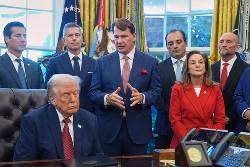
"From day one I’ve been taking action to make buying a car more affordable.” Trump said at a White House event that included top executives from the three largest U.S. automakers.
The rule reverses a Biden-era policy that "forced automakers to build cars using expensive technologies that drove up costs, drove up prices and made the car much worse,” Trump said.
Rule change will save money, Trump says
The action is expected to save consumers about $1,000 off the price of a new car, Trump said. New cars sold for an average of $49,766 on average in October. according to Kelley Blue Book.
Automakers applauded the planned changes. They had complained that the Biden-era rules were difficult to meet.
Ford CEO Jim Farley said the planned rollback was “a win for customers and common sense.”
“As America’s largest auto producer, we appreciate President Trump’s leadership in aligning fuel economy standards with market realities. We can make real progress on carbon emissions and energy efficiency while still giving customers choice and affordability,” Farley said.
Stellantis CEO Antonio Filosa said the automaker appreciates the administration’s actions to “realign” the standards “with real world market conditions.”
Since taking office in January, Trump has relaxed auto tailpipe emissions rules, repealed fines for automakers that do not meet federal mileage standards and terminated consumer credits of up to $7,500 for EV purchases.
Environmentalists decried the rollback in mileage standards.
“In one stroke Trump is worsening three of our nation’s most vexing problems: the thirst for oil, high gas pump costs and global warming,” said Dan Becker, director of the Safe Climate Transport Campaign for the Center for Biological Diversity.
“Gutting the (gas-mileage) program will make cars burn more gas and American families burn more cash,'' said Katherine García, director of the Sierra Club's Clean Transportation for All program.
Polluting cars to stay on road
“This rollback would move the auto industry backwards, keeping polluting cars on our roads for years to come and threatening the health of millions of Americans, particularly children and the elderly,” she said.
Trump has repeatedly pledged to end what he falsely calls an EV “mandate,” referring incorrectly to Democratic President Joe Biden’s target that half of all new vehicle sales be electric by 2030. EVs accounted for about 8% of new vehicle sales in the United States in 2024, according to Cox Automotive.
No federal policy has required auto companies to sell EVs, although California and other states have imposed rules requiring that all new passenger vehicles sold in the state be zero-emission by 2035. Trump and congressional Republicans blocked the California law earlier this year.
Transportation Secretary Sean Duffy urged his agency to reverse existing fuel economy requirements, known as Corporate Average Fuel Economy, soon after taking office. In June, he said that standards set under Biden were illegal because they included use of electric vehicles in their calculation. EVs do not run on gasoline. After the June rule revision, the traffic safety agency was empowered to update the requirements.
Under Biden, automakers were required to average about 50 miles (81 kilometers) per gallon of gas for passenger cars by 2031, compared with about 39 miles (63 kilometers) per gallon today. The Biden administration also increased fuel-economy requirements by 2% each year for light-duty vehicles in every model year from 2027 to 2031, and 2% per year for SUVs and other light trucks from 2029 to 2031. At the same time, it called for stringent tailpipe rules meant to encourage EV adoption.
The 2024 standards would have saved 14 billion gallons of gasoline from being burned by 2050, according to the National Highway Traffic Safety Administration’s 2024 calculations. Abandoning them means that in 2035, cars could produce 22,111 more tons of carbon dioxide per year than under the Biden-era rules. It also means an extra 90 tons a year of deadly soot particles and more 4,870 tons a year of smog components nitrogen oxide volatile organic carbons going into the air in coming years.
Mileage rules have been implemented since the 1970s energy crisis, and over time, automakers have gradually increased their vehicles’ average efficiency.
___
St. John reported from Detroit. Associated Press writers Darlene Superville and Seth Borenstein contributed to this report.
___
The Associated Press’ climate and environmental coverage receives financial support from multiple private foundations. AP is solely responsible for all content. Find AP’s standards for working with philanthropies, a list of supporters and funded coverage areas at AP.org.
...