


Frustrated and anxious travelers searched Tuesday for any way out of the Middle East and beyond as the widening Iran war choked off commercial air traffic through the region for a fourth straight day, stranding hundreds of thousands of people.
What began Saturday with U.S. and Israeli strikes on Iran quickly rippled far beyond the immediate conflict zone. With airspace closed or heavily restricted across much of the Gulf, passengers have been stranded not only in the region but also in cities far from the fighting after their connecting flights were canceled.
“They say ‘Get out,’ but how do you expect us to get out when airspaces are closed?” said Odies Turner, a 32-year-old chef from Dallas who was stuck in Doha, Qatar. “They just have been canceling every flight. I want to go home.”
The U.S. told American citizens to leave more than a dozen countries in the region right away using any available commercial transportation. The countries include Iran and Israel, as well as Qatar, Bahrain, Egypt, Iraq, Jordan, Kuwait, Lebanon, Oman, the Palestinian territories, Saudi Arabia, Syria, the United Arab Emirates and Yemen.
But commercial options remained limited.
More than 19,000 of the roughly 51,600 flights scheduled into and out of the Middle East between the start of the war and Friday have been canceled, according to aviation analytics firm Cirium.
Governments explore repatriation flights
The U.S. State Department said Tuesday it was “actively securing” military and charter aircraft to fly Americans out of the region. It said it was in contact with nearly 3,000 citizens seeking assistance or information.
“We know that we’re going to be able to help them,” U.S. Secretary of State Marco Rubio told reporters Tuesday, while cautioning that “it's going to take a little time because we don’t control the airspace closures."
Rubio urged stranded Americans to contact the State Department: "We need to know who you are.”
Earlier in the day, U.S. Ambassador Mike Huckabee said the U.S. Embassy in Jerusalem was “not in a position at this time to evacuate or directly assist Americans in departing Israel.” He provided information ”as a courtesy to those wishing to leave" about an Israeli government shuttle bus to Egypt that Americans could try “as you make your own security plans.”
Israel’s airspace has been closed since Saturday, although some land crossings remain open.
El Al, Israel's flag carrier, said it was launching a large-scale “recovery operation.” Transportation Minister Miri Regev said Ben-Gurion Airport is preparing to gradually reopen for limited incoming flights starting early Thursday.
Under the plan, one passenger flight per hour will be allowed in the first 24 hours — totaling about 5,000 people — with more possible depending on security conditions. It is unclear whether only Israelis will be permitted on the flights, and no commercial departures leaving Israel have been approved.
Australia said a commercial flight from Dubai to Sydney was scheduled Wednesday to start repatriating 24,000 Australians stranded in the UAE.
“This is a consular crisis that dwarfs any that Australia has had to deal with in terms of numbers of people,” Foreign Minister Penny Wong told Australian Broadcasting Corp.
Waiting and watching
Across the Middle East, travelers waited in terminals and hotels, or stayed inside because of airstrikes. Some cruise passengers were unable to disembark or reroute because ships could not sail through the Strait of Hormuz.
Matt Carwell, an American staying in Dubai, was speaking with The Associated Press by phone from his hotel balcony when he suddenly stopped midsentence.
“Wow,” the 46-year-old said. “There was just a boom.” A fighter jet roared overhead moments later.
Carwell, who volunteers at a New Hampshire school, has flights booked and keeps waiting for one that doesn't get canceled.
“Right now, we’re safe and comfortable,” he said, but not everyone is. “Just feel for them and feel for the people who have either lost their lives or lost someone they're close to.”
Airspace across Iran, Iraq, Israel, Qatar, Bahrain, Kuwait and Syria were still shut Tuesday, according to flight-tracking service Flightradar24. The UAE declared its airspace partially closed, and Jordan suspended flights daily from the mid-afternoon until 6 a.m. local time.
The geography of the war has magnified the disruption to air travel. Gulf airports connect Europe, Africa and Asia, and carriers routinely funnel long-haul passengers through hubs such as Dubai and Doha.
“Within the Middle East, an eight-hour flying distance covers two-thirds of the world population,” said Anita Mendiratta, an aviation and tourism consultant who was stranded in Bangkok. When that corridor is blocked, Mendiratta said, it forces planes far north or south, which "puts huge pressure on the airlines.”
Some of the aviation notices governing the closures allow authorities to reopen or restrict portions of airspace on short notice depending on security conditions, meaning flight schedules can change rapidly as the conflict continues to unfold.
Some begin to leave
Despite the uncertainty, some travelers have managed to catch flights.
Oman Airways advertised flights from Muscat International Airport for passengers able to reach the city from the UAE. Virgin Atlantic said it planned to resume limited service between London Heathrow and both Dubai and Riyadh, the capital of Saudi Arabia.
Oman’s airspace remained open, while Saudi Arabia kept most of its airspace operating despite partial closures near its border with Iraq and along the Persian Gulf — making Muscat and Riyadh key staging points for repatriation efforts.
Some wealthy travelers are paying large sums for luxury flights to Europe, first traveling overland to Muscat or to Riyadh to reach airports considered safe from Iranian drone and missile attacks. Prices for charter flights have soared since the start of the war.
Emirates and Etihad operated a limited number of repatriation flights Tuesday, even as their regular commercial schedules remained suspended. Both carriers said the departures were focused on moving stranded passengers and operating cargo or repositioning flights with government approval.
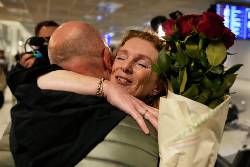
“We called our children at 3 a.m. to ask forgiveness because we might die and to tell them we love them,” said Mariana Muicaru, one of hundreds of Romanian pilgrims who had been stranded on a church trip to Israel. She described watching rockets streak across the sky, before eventually reaching Bucharest on Tuesday.
In Germany, passengers arriving in Frankfurt from Dubai on Tuesday were asked by reporters if they were glad to be home.
“Yes, of course,” Wassim Mahlas said. “I’m breathing German air again.”
___
Associated Press journalists around the world contributed to this report, including Danica Kirka, Daniel Niemann, Kristen Grieshaber, Nicolae Dumitrache, Samy Magdy, Jovana Gec, Josh Funk, Julie Walker and Rod McGuirk.
...