


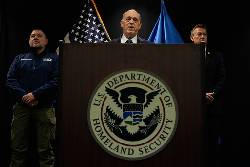
MINNEAPOLIS (AP) — The Trump administration could reduce the number of immigration enforcement officers in Minnesota, but only if state and local officials cooperate, the president's border czar said Thursday, noting he has “zero tolerance” for protesters who assault federal officers or impede the ongoing Twin Cities operation.
Tom Homan addressed reporters for the first time since the president sent him to Minneapolis following last weekend's fatal shooting of protester Alex Pretti, the second this month by federal officers carrying out the operation. His comments came after President Donald Trump seemed to signal a willingness to ease tensions in the Minneapolis and St. Paul area and as the administration ended its “enhanced operations” in Maine.
Homan emphasized that the administration isn't relenting on its immigration crackdown and warned that protesters could face consequences if they interfere with federal officers.
But he seemed to acknowledge there had been missteps.
“I do not want to hear that everything that’s been done here has been perfect. Nothing’s ever perfect,” he said.
A possible downsizing
Homan hinted at the prospect of pulling out many of the roughly 3,000 federal officers taking part in the operation, but he seemed to tie that to cooperation from state and local leaders and a reduction in protester interference.
“The drawdown is going to happen based on these agreements," he said. "But the drawdown can happen even more if the hateful rhetoric and the impediment and interference will stop.”
He also said he would oversee internal changes in federal immigration law enforcement, but he gave few specifics.
“The mission is going to improve because of the changes we’re making internally,” he said. “No agency organization is perfect. And President Trump and I, along with others in the administration, have recognized that certain improvements could and should be made.”
Minneapolis Mayor Jacob Frey told reporters in Washington on Thursday he was “hopeful” that the number of federal officers in the city would be reduced. He said police would do their jobs but not “somebody else's,” referring to federal law enforcement.
Despite Trump softening his rhetoric about Minnesota officials — he said this week they were on a “similar wavelength” — there has been no visible sign of any big changes to the operation. On Thursday, as the Justice Department charged a man accused of squirting vinegar on Democratic Rep. Ilhan Omar, a smattering of protesters braved the frigid temperatures to demonstrate outside of the federal facility that has been serving as the operation's main hub.
Pretti, 37, was fatally shot Saturday during a scuffle with the Border Patrol. Earlier this month, 37-year-old Renee Good was shot in her vehicle by an Immigration and Customs Enforcement officer.
A plea for cooperation
Homan doubled down on the need for jails to alert ICE to inmates who could be deported, saying that transferring such inmates to the agency while they’re still in jail is safer because it means fewer officers have to be out looking for people who are in the country illegally. ICE has historically relied on cooperation from local and state jails to notify the agency about such inmates.
“Give us access to illegal aliens, public safety threats in the safety and security of a jail,” he said.
The border czar, whose arrival followed the departure of the Trump administration’s on-the-ground leader of the operation, Border Patrol chief Greg Bovino, also seemed to suggest a renewed focus on what ICE calls “targeted operations” focused on apprehending immigrants who have committed crimes. Homan said the agency would conduct “targeted strategic enforcement operations” prioritizing “public safety threats.”
A targeted approach to arrests
It remains to be seen whether ICE's renewed focus on “targeted operations” might reduce tensions.
ICE and Homan have long said the Trump administration's primary focus is to arrest people in the country illegally who have a criminal history or pose a threat to public safety. But they acknowledge they'll also arrest anyone else found to be in the U.S. illegally.
They argue that ICE operations target specific people, as opposed to carrying out indiscriminate raids where officers round up everyone and demand their papers.
Sameera Hafiz, policy director with the Immigrant Legal Resource Center, said Homan's comments seemed to reflect a recognition that public opinion has turned against ICE, but she questioned his argument that carrying out targeted operations would make the country safer.
“His comments still seem to be based on the false premise that deporting people or deportation will make our community safer,” she said. “All the evidence and data has shown that deportations don’t make our communities safer. They destabilize families, they tear communities apart, they hurt our economy.”
Homan didn't give a specific timeline for how long he would stay in Minnesota.
“I’m staying until the problem’s gone,” he said, adding that he has met with community, law enforcement and elected leaders in the hopes of finding common ground and suggested that he’s made some progress.
___
Santana reported from Washington. Associated Press reporters Tim Sullivan in Minneapolis, Mike Catalini in Trenton, New Jersey, and Steven Sloan in Washington contributed.
...