


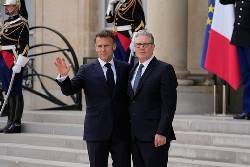
PARIS (AP) — The leaders of France and the U.K. gathered dozens of countries — but not the United States — on Friday to push forward plans to reopen the Strait of Hormuz, a key oil shipping route choked off by the U.S.-Israeli war on Iran.
The Paris meeting is part of attempts by sidelined nations to ease the impact of a conflict they didn’t start and haven’t joined, but that has sent the global economy reeling. After the war started on Feb. 28, Iran effectively shut the narrow strait though which a fifth of the world’s oil usually passes.
Macron’s office said the summit Friday afternoon gathered about 50 nations and international organizations, including over 30 heads of state and government. The list has not been disclosed. German Chancellor Friedrich Merz and Italian Premier Giorgia Meloni were attending in person, while others joined by video.
The U.S. is not part of the planning for what has been branded the Strait of Hormuz Maritime Freedom of Navigation Initiative. In a post on X ahead of Friday’s conference, French President Emmanuel Macron said the mission to provide security for shipping through the strait would be “strictly defensive,” limited to non-belligerent countries and deployed “when security conditions allow.”
British Prime Minister Keir Starmer, facing political troubles at home, was greeted by Macron in the courtyard of the Elysee presidential palace on Friday afternoon.
Macron and Starmer have spearheaded international efforts to increase diplomatic and economic pressure on Iran, which Starmer has accused of “holding the world’s economy to ransom.” U.S. President Donald Trump’s announcement of a retaliatory American blockade of Iranian ports has raised the economic jeopardy even higher.
“The unconditional and immediate reopening of the Strait is a global responsibility, and we need to act to get global energy and trade flowing freely again,” Starmer said before the meeting.
Military planning underway
France and Britain also have led military planning meetings, in an echo of the “coalition of the willing” assembled to provide security for Ukraine in the event of a ceasefire in that war.
French military spokesperson Col. Guillaume Vernet said Thursday that the mission is still “in construction.”
Macron's office said participants will contribute “each according to its capabilities,” stressing options to ensure safe passage through the strait will depend on the security situation after a lasting ceasefire.
“What matters is that ship operators have all the means at their disposal to be sure their vessels will not be hit if they pass through the strait. That may require intelligence, mine-clearing capabilities, military escorts, communication procedures with coastal states, etc.,” an official said, speaking on condition of anonymity in line with the French presidency's customary practices.
Sidharth Kaushal, a research fellow in sea power at the Royal United Services Institute think tank, said mine-clearing and creating a warning system for maritime threats were more likely roles for the coalition than warships escorting commercial tankers though the strait.
“You need huge numbers of vessels for that sort of thing, which nobody has,” he said.
Iran expert Ellie Geranmayeh, deputy head of the Middle East and North Africa program at the European Council on Foreign Relations think tank, said mine-clearing is an area where European countries and their partners could play a role.
“They would be a better party to do this than the United States, because once you have U.S. military doing this and lingering on Iranian shores, it creates a potential arena for Iran and the U.S. to have miscalculations and get back into a sort of military tension,” she said.
Dozens of countries involved in talks
Britain has discussed using mine-hunting drones, deployed from the ship RFA Lyme Bay, for a Hormuz mission.
The war has highlighted the shrunken state of the Royal Navy, which has deployed just one major warship, destroyer HMS Dragon, to the eastern Mediterranean. France, which has the European Union’s most powerful military, has sent its nuclear-powered aircraft carrier to the region, alongside a helicopter carrier and several frigates.
More than 40 nations have taken part in diplomatic or military meetings led by France and the U.K. in recent weeks, though fewer are likely to commit military resources.
The operation is partly a response to Trump, who has berated allies for failing to join the war and said reopening the strait is not America's job. The president has called allies “cowards,” said NATO “wasn’t there when we needed them” and telling Britain: “You don’t even have a navy.”
“I imagine there’ll be some desire on the part of many European states, and potentially Canada, to demonstrate the ability to provide security in a way that’s distinct from, if not completely separate from, the U.S. and which also demonstrates a capacity for independent action,” Kaushal said.
“How many states actually have spare capacity to offer to this is a pretty open question.”
___
Lawless reported from London.
...