


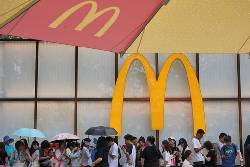
McDonald’s said Wednesday it will spend $8.5 billion over the next decade to modernize its restaurants globally.
Fast-food traffic in many markets, including the U.S., is flat, so for McDonald’s to continue to grow it has to grab share from competitors and improve restaurant productivity, McDonald’s Chairman and CEO Chris Kempczinski said at a meeting with investors at the company’s Chicago headquarters. McDonald's wants to automate more tasks, like inventory and scheduling, and improve kitchen operations.
“The winners will be the companies that create more demand and deliver it more efficiently,” Kempczinski said.
McDonald's shares fell 5% in afternoon trading Wednesday, their largest percentage drop in six years, as investors shuddered at the eye-popping price of improving McDonald's 46,000 global stores.
On the product side, McDonald's said hand-breaded chicken, which is being tested at 10,000 restaurants in Asia and a handful of restaurants near Chicago, has boosted sales and quality ratings. Many of McDonald's competitors, like Chick-fil-A and KFC, offer hand-breaded chicken. The company plans to expand its testing to more markets in the U.S. and Ireland next year.
McDonald's also plans to introduce grilled chicken sandwiches and wraps in the U.S. and other markets and experiment with products like egg bites and bowls to meet the needs of customers who are seeking more protein and varied portion sizes.
Skye Anderson, the president of McDonald’s USA, said approximately 30 million Americans are now using GLP-1 weight loss drugs, and they’re seeking smaller, more protein-packed meals as a result. But the company’s research indicates that 60 million Americans are actively seeking more protein in their diet.
“This is an opportunity. We need to keep giving them more reasons to make McDonald’s their first choice,” Anderson said at McDonald’s investor day.
McDonald’s said the restaurant modernizations include lockers to handle delivery orders, more visible coffee preparation areas to enhance quality perceptions, bigger play areas and improved kitchen layouts. Scales to help ensure order accuracy – which are already in use at 10,000 restaurants globally – will be in 20,000 restaurants by 2028, McDonald’s said.
The company is deploying its ArchIQ system, developed with Google, that improves order accuracy with artificial intelligence and automates tasks like inventory management and scheduling. Archy, the company's AI-enabled drive-thru ordering system, is now capable of taking orders in Spanish and English with a 90% accuracy rate.
Archy could eventually reduce at least 50 labor hours per week in a typical McDonald's, Chief Financial Officer Ian Borden said. But he said the intention is not to reduce staffing. Instead, employees can focus more on hospitality or on tasks like hand-breading chicken.
Kempczinski said customers have responded positively to Archy in testing because it helps make their orders more accurate.
“It's not AI is bad or AI is good. We try to be really thoughtful about how we use it,” he said.
McDonald's is also rolling out new employee training that will focus on hospitality and food quality, said Tiffanie Boyd, McDonald's chief people officer. The training will be more experience-based, showing employees what a perfectly cooked Big Mac tastes like, for example, and will encourage more pleasant interactions with customers.
At the same time, McDonald's is still focused on value. Kempczinski said low-income consumers, defined as U.S. households making $45,000 or less, continue to go out for fast food but not as often as they used to. McDonald's has done a good job with meal bundles, like its $5 meal deal, he said. But the company is exploring ways to offer entry-level prices on a basic menu of items in the U.S., as it does in Europe and other markets.
“This is the environment that we’re in right now. You have to be on your game and deliver that value,” Kempczinski said. “The pressure around cost of living isn't going away.”
McDonald’s U.S. franchisees typically spend up to $450,000 per decade to on required store remodels. Under the company’s new plan, they will have to spend an additional $800,000 over time, but McDonald’s will pay a portion of that cost in the form of rent relief and capital support.
Borden said the investments will be phased in over time when markets and individual franchisees are ready for them. Once the investments are made, the efficiency improvements will deliver roughly $100,000 in annual cash flow benefits to the average U.S. restaurant, some of which can be reinvested in the restaurant, Borden said.
“We'd love to see it going into hospitality to elevate the experience with our customers,” Borden said.
...