


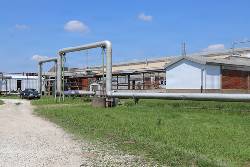
The U.S. Army has detonated a dangerous and degraded stockpile of lead azide in Iowa on Wednesday.
Here's what to know about lead azide, and why local officials and scientists have some concerns about potential health and environmental effects from the explosion.
Lead azide, which typically appears as a white or colorless crystalline powder or needlelike crystals, is a highly sensitive chemical compound containing lead and nitrogen.
The compound is used as an initiating explosive in munitions, and historically has been used in detonators to set off other explosives, such as TNT.
It is sensitive to shock, heat, impact and friction, and may explode when dry. With temperature changes and time, lead azide can form unstable, larger crystals that are even more sensitive.
The decades-old lead azide supply in Iowa was crystallizing, posing the risk of spontaneous detonation.
Broken down, lead is a toxic heavy metal that can harm the brain, nervous system, kidneys, heart and other organs. Lead exposure also causes developmental damage.
As lead exposure can pose both immediate risks and longer health and environmental hazards, officials and researchers are questioning the levels of lead that might be in the air and nearby land and water sources, impacting residents, crops, cattle and wildlife after the detonation.
The military stopped using lead azide in the 1980s because of its hazards.
The Army says safety preparations ahead of Wednesday's detonation included barriers around the blast zone to reduce the spread of the resulting plume, along with ballistic gels to absorb lead dust.
___
Alexa St. John is an Associated Press climate reporter. Follow her on X: @alexa_stjohn. Reach her at ast.john@ap.org.
___
Read more of AP’s climate coverage.
___
The Associated Press’ climate and environmental coverage receives financial support from multiple private foundations. AP is solely responsible for all content. Find AP’s standards for working with philanthropies, a list of supporters and funded coverage areas at AP.org.
...