


GENEVA (AP) — Iran’s place at the men’s World Cup in three months’ time was put in doubt Monday amid an escalating Middle East conflict sparked by the soccer tournament's co-host the United States.
Iran is due to play its three group stage games in the U.S. — two in Inglewood, California, then in Seattle — from June 15-26. Cities in Canada and Mexico also will host some of the 104 games.
The U.S. and Israel have targeted Iran in coordinated attacks since Saturday that killed Supreme Leader Ayatollah Ali Khamenei and dozens more senior officials.
It provoked an Iranian response that aimed missiles at U.S. allies including 2022 World Cup host Qatar and Saudi Arabia, which FIFA has picked to stage the 2034 edition.
“What is certain is that after this attack, we cannot be expected to look forward to the World Cup with hope,” said Iran’s top soccer official Mehdi Taj, a vice president of the Asian Football Confederation.
It is unclear if the state-backed Iranian soccer federation could refuse to send its team to the 48-nation tournament that starts June 11, or the U.S. government could effectively block the team.
FIFA has declined comment since Saturday, when secretary general Mattias Grafström said it would “monitor developments around all issues around the world.”
The White House's top official overseeing World Cup preparations, Andrew Guiliani, seemed unconcerned Saturday in a social media post.
“We’ll deal with soccer games tomorrow,” Guiliani wrote about Iran, “tonight, we celebrate their opportunity for freedom.”
Here is a look at the issues in play:
Asian soccer power
Iran has one of the best national teams in Asia and has qualified for six of the past eight World Cups.
It is No. 20 in the FIFA world rankings of 211 teams, and has not been lower than No. 24 since the last World Cup in Qatar.
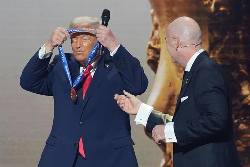
Iran was among the second-seeded teams in the World Cup draw held in Washington, D.C. in December, minutes after U.S. President Donald Trump was presented with the inaugural FIFA Peace Prize.
Though Taj and other Iranian soccer officials were denied visas to enter the U.S., the draw outcome was favorable for Iran, especially in the expanded format where most third-place teams advance to the knockout rounds.
Iran starts against low-ranked New Zealand, then plays one of the weaker top-seeded nations, Belgium, and finishes against Egypt.
Iran is likely to be supported in stadiums by its diaspora in the U.S., though residents of the Middle East nation are subject to a ban on entering the country.
Trump's government has promised exemptions from its travels bans for athletes and coaches arriving for major sports events like the World Cup.
Politics around Iran inside World Cup stadiums is nothing new. Protests over domestic issues were aired by Iran fans at the last World Cup.
The FIFA rules
FIFA’s World Cup regulations envisage a team withdrawing, or being excluded, from the tournament though the legal language is vague to say the least.
In that scenario, according to Article 6.7, “FIFA shall decide on the matter at its sole discretion and take whatever action is deemed necessary.”
“FIFA may decide to replace the Participating Member Association in question with another association,” the rules say.
That legal framing seems to give FIFA president Gianni Infantino wide powers to shape any decision relating to Iran.
Just 18 months ago, the decision announced by Infantino to add Lionel Messi’s team Inter Miami to the 2025 Club World Cup lineup appeared to have no basis in formal tournament rules.
Consequences of withdrawing
Should Iran pull out of the World Cup — still hugely speculative — its soccer federation would forfeit at least $10.5 million.
FIFA pays $9 million in prize money to each of the 16 federations whose teams fail to advance from the group stage, and all 48 qualified teams get $1.5 million “to cover preparation costs.”
The Iranian federation also would face disciplinary fines from FIFA — at least 250,000 Swiss francs ($321,000) for withdrawing up to 30 days before the tournament, and at least 500,000 Swiss francs ($642,000) if the decision is in the last month before kickoff.
Iran would risk being excluded by FIFA from qualifying for the next World Cup in 2030 as well.
Next in line
Iran was a fast World Cup qualifier last March, earning one of eight guaranteed places allocated to the Asian Football Confederation.
Should Iran pull out, the likely replacement from Asia should be Iraq or the United Arab Emirates.
Iraq and the UAE were effectively the ninth and 10th-ranked Asian teams through the various qualifying groups and advanced to a two-leg playoff last November.
Iraq won 3-2 on aggregate — eliminating the UAE — to advance to the intercontinental playoffs in Mexico and, on March 31, it is scheduled to play an elimination game against Bolivia or Suriname with a World Cup place at stake.
One possible element of uncertainty is the language of the World Cup tournament rules.
FIFA wrote that it can decide to replace a withdrawn team “with another association,” though without specifying the replacement must come from the same continental confederation.
Precedent of a late replacement
Denmark famously won the 1992 European Championship after getting a late invitation from UEFA, European soccer's ruling body.
Yugoslavia won a qualifying group ahead of the Danes but was removed by UEFA less than two weeks before the tournament because of a United Nations sanctions resolution during the widening Balkans conflict.
Teams have previously refused to travel to a World Cup, though not in the modern era.
Just 13 teams instead of 16 took part in the 1950 World Cup in Brazil, with India and Scotland among teams declining a place.
___
AP soccer: https://apnews.com/hub/soccer
...