


MILTON, Mass. (AP) — Perched in a tower atop a hill, Matthew Douglas climbs a staircase and emerges from a hatch on the roof, where a heavy glass ball in a metal cradle has burned a thin streak into a strip of paper, recording the previous day's sunlight.
It’s part of a routine he and other weather observers at Blue Hill Observatory and Science Center, a weather station 15 miles (24 kilometers) south of Boston, have followed every day for the last 141 years. Using largely unchanged analog tools, they have built a continuous record of temperature, humidity, precipitation, wind and other measurements that can feed weather forecasts and scientific research.
“My routine is the same every day,” said chief weather observer Douglas, who has worked there since 1997, sporting a dark blue sweatshirt with the name of the observatory on the front. “The only thing that changes are the numbers and the weather itself.”
Blue Hill is the nation’s oldest continually operating weather observatory, according to executive director Alex Evans. Since 1885, staff and volunteers have relied on many of the same instruments, including mercury and alcohol thermometers, hygrometers that use human hair to measure moisture in the air, and that glass sphere on the roof tracking the hours of bright sunshine.
Keeping the same tools in the same place for nearly a century and a half, Douglas said, means that if they spot a change in weather patterns, they can be sure it’s real and not a result of new instruments measuring data differently than the old ones. Having a “tried and true database” as a reference is very important for climate research, he added.
___
EDITOR’S NOTE: This story is a collaboration between the MIT Graduate Program in Science Writing and The Associated Press.
___
As climate science has come under fire from the Trump administration, budget cuts and layoffs have swept through federal weather institutions since 2025. Blue Hill, as a private nonprofit, avoided much of this maelstrom. However, its continuing work is not a given. Funding opportunities are limited in this political environment, Evans said.
Blue Hill’s work, though seemingly outpaced by modern technology, serves not just to keep weather records, but also to connect ordinary people to climate science.
A continuous weather record in America makes climate change visible
Few weather observatories in the U.S. are as old as Blue Hill, and fewer still continue to collect data manually. Though similar methods are still used by networks of volunteers across the country that feed data to the National Weather Service, weather observatories — both private ones and those affiliated with the National Oceanic and Atmospheric Administration — have adopted automated digital systems since at least the 1990s.
Blue Hill sends a daily summary of its observations to the National Weather Service, which chief scientist Michael Iacono said may contribute to weather forecasts in some circumstances, and monthly summaries to the National Centers for Environmental Information, where they can be distributed to climate researchers. Local television meteorologists also receive the daily summaries and may use the observations in their broadcasts in rare cases, he said.
Inside Blue Hill’s round tower, which stands three stories tall with castle-like notches at the top, two weather observers, Douglas and Amanda Joly, share an office filled with the results of their daily work. Boxes with sun cards line the walls, wind-speed charts drawn on EKG paper fill the cabinets and computers store the spreadsheets where Douglas and Joly meticulously record temperature and humidity.
Having records that stretch back over 100 years “is really unique,” said Chris Fiebrich, a meteorologist at the University of Oklahoma. This “dataset is golden,” he said, because climate change involves slow trends so “you can only see that clearly if you have measurements that go way back, from before we had satellites” and other modern equipment.
Blue Hill’s records show, for example, a 5-degree Fahrenheit (or about 2.8-degree Celsius) increase in the average annual temperature at the observatory since 1885, and that two local ponds remain frozen during winter nearly three weeks less than they did then.
Observers can also spot the impact of climate policies. Since the 1990s, Blue Hill has recorded an uptick in bright sunlight duration after it reached a low point in the 1980s. Because air pollutants like particulate matter interfere with sunlight, cleaner air means more sunshine, so this uptick can partly be traced back to the Clean Air Act — a federal law passed in 1970 and amended in 1990 to improve air quality by reducing emissions of pollutants.
A third of Americans believe climate scientists understand “not too well” or “not at all well” whether climate change is happening, according to a Pew Research Center survey from 2023. Trump called climate change “the greatest con job ever perpetrated on the world” in a speech at the United Nations General Assembly last September, and has sought to undermine climate science.
At a time when “the word ‘climate’ is politically demonized in some circles,” said Alan Sealls, president of the American Meteorological Society, places like Blue Hill can be “a small part of many possible solutions” to make weather and climate science relatable to people, including children.
Blue Hill connects people to science
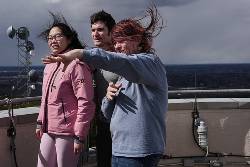
The road to Blue Hill Observatory is a winding asphalt track that weaves through forest and borders a ski lift; making the drive, one needs to carefully wend between hikers and dog walkers. At the peak, visitors can enjoy the westward view over the treetops or slip through an open arch into the observatory’s courtyard.
Annie Hayes, a local from Milton who visited Blue Hill in mid-March with her husband and two children, said that seeing how observers collect data builds deeper trust in the science, which otherwise can seem “a little bit of a mystery.”
The mercury barometers in the observers’ office — one of which the observatory believes to be the oldest such instrument in active daily use in the United States — are a case in point. “If somebody’s standing there seeing it while you’re explaining it to them … it becomes a little less scary,” said chief scientist Iacono.
Blue Hill’s barometers, which measure atmospheric pressure, consist of glass tubes and small containers of mercury — a shiny, silver-white liquid — housed in a wooden case on the wall. As air presses down on the exposed mercury, it is forced up the tubes, and how far it travels reflects changes in atmospheric pressure. This is where the pressure unit “inches of mercury” comes from.
Another instrument popular with visitors is the Campbell-Stokes recorder, used to measure hours of bright sunshine. Its glass sphere, mounted in a curved metal frame, acts as a magnifying lens, focusing sunlight onto a paper card and burning a streak along it as the sun moves through the sky.
As she pointed to the glass sphere on display in the history room, Amanda Joly, Blue Hill’s deputy chief observer, explained that this recorder, which dates back to 1898, was stolen in 1993 and later recovered. The upside of that burglary is that, while a modern duplicate does the job on the building’s roof, visitors are now free to interact with the old sphere — something kids love to do — and the observers don’t have to worry about it affecting the measurements.
Hayes’ family, which lives nearby, was checking out some rain gauges in the gift shop when facilities head Don McCasland told them about a new Blue Hill citizen science program, which will allow residents to collect and add weather data to a central database. The family plans to start using their rain gauge this summer.
It’s “a great way to involve the kids and get them excited,” said Hayes. “And who knows? Maybe they’ll find an interest and want to pursue it on their own, too.”
___
The Associated Press’ climate and environmental coverage receives financial support from multiple private foundations. AP is solely responsible for all content. Find AP’s standards for working with philanthropies, a list of supporters and funded coverage areas at AP.org.
...