


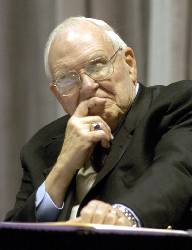
Roy Kramer, who as commissioner of the Southeastern Conference helped transform the league into a national power while reshaping the entire sport of college football with a precursor to today’s playoff system, has died. He was 96.
Kramer died on Thursday in Vonore, Tennessee, the SEC said.
Kramer served as SEC commissioner from 1990 through 2002. He was the first to imagine a conference title game, which divided his newly expanded 12-team league into divisions and pitted the two champs in a winner-take-all affair that generated millions in TV revenue.
That led to his greatest contribution — the Bowl Championship Series system that moved college football away from its long-held tradition of determining a champion via media and coaches’ polls. The system in place from 1998 through 2013 produced its share of predictable debate and caused annual frustration for a large segment of the sport’s fans, but the pathway had been created for the true tournament format that’s held in just about every other team sport. A four-team playoff replaced the BCS in 2014, and that was expanded to 12 teams starting last season.
Kramer served as coordinator of the BCS from 1995-99 when the system was developed using computerized formulas to determine which two teams should play in the top bowl game for the title.
Kramer was named the SEC’s commissioner in 1990 and made it one of the richest conferences in the nation during his tenure, mostly by successfully negotiating lucrative television contracts. He began by bringing Arkansas and South Carolina into the conference in 1991 — a small preview of the massive expansion that has overrun the sport some 35 years later.
That allowed him to introduce the SEC title game, which added to a growing font of media revenue. In Kramer’s last year, the SEC distributed $95.7 million in revenue to its 12 member schools, a jump from 1990 when the SEC brought in $16.3 million. In the 2023-24 fiscal year, the SEC distributed $808.4 million — a testament to the exponential growth in college sports that Kramer envisioned back in the ’90s.
Kramer insisted the vitriol that stemmed from BCS selections wasn’t a knock on the system itself but rather a welcomed byproduct because it brought attention to college football.
The BCS has been “blamed for everything from El Nino to the terrorist attacks,” Kramer joked in 2002 when announcing his retirement.
“Roy Kramer will be remembered for his resolve through challenging times, his willingness to innovate in an industry driven by tradition, and his unwavering belief in the value of student-athletes and education,” current SEC Commissioner Greg Sankey said.
Born Roy Foster Kramer in Maryville, Tennessee, on Oct. 30, 1929, he earned a bachelor’s degree from Maryville College, where he was a football lineman and wrestler. Kramer earned a master’s at the University of Michigan and served three years in the Army during the Korean War.
He coached football at five high schools in Michigan before he was named assistant coach at Central Michigan in 1965 and then head coach in 1967. Kramer was named the 1974 national coach of the year after leading Central Michigan to the Division II national championship and went 83-32-2 over 11 seasons in charge of the Chippewas. Kramer ended his coaching career in 1978 when he became athletic director at Vanderbilt, where he served until he left for the SEC.
Kramer didn’t want to admit he left a legacy in college athletics, but he was widely admired and respected.
“By any standard,” former Big East commissioner Mike Tranghese said in 2002, “Roy’s influence has been mind-boggling.”
___
Get poll alerts and updates on the AP Top 25 throughout the season. Sign up here and here (AP News mobile app). AP college football: https://apnews.com/hub/ap-top-25-college-football-poll and https://apnews.com/hub/college-football
...