


VATICAN CITY (AP) — The Vatican on Monday gave a final accounting of its 2025 Holy Year, saying more than 33 million pilgrims had participated and that the only real dispute with the city of Rome concerned the style of fountains built for the event's main public works project.
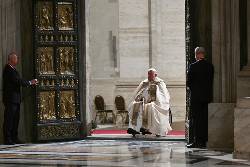
Pope Leo XIV on Tuesday will officially close out the Holy Year and shut the Holy Door of St. Peter’s Basilica, capping a rare Jubilee that was opened by one pope and closed by another.
For the Vatican, a Holy Year is a centuries-old tradition of the faithful making pilgrimages to Rome every 25 years to visit the tombs of Saints Peter and Paul and receive indulgences for the forgiveness of their sins.
For Rome, it’s a chance to take advantage of some 4 billion euros ($4.3 billion) in public funds to carry out long-delayed projects to lift the city out of years of neglect and bring it up to modern, European standards.
Participation grew after Francis' death
The Vatican said 33,475,369 pilgrims had participated and Italy, the U.S. and Spain were the top nationalities represented.
But the Vatican’s Holy Year organizer, Archbishop Rino Fisichella, acknowledged the number was only an estimate and could include double counting. There was no breakdown between Holy Year pilgrims and Rome’s overall tourism numbers.
The Vatican arrived at the figure by combining the number of people who officially registered for Jubilee events, volunteer crowd counters at Rome-area basilicas and closed-circuit television cameras at St. Peter’s Basilica, which recorded around 25,000 to 30,000 people a day crossing the threshold of the Holy Door.
Assuming that number every day for the past year, around 10 million pilgrims would have crossed through the Holy Door. Officials said they never envisioned more, given its limited capacity and that pilgrims would have visited Holy Doors at other Rome basilicas.
The official number exceeded the 31.7 million people originally forecast by a study conducted by the Roma Tre University.
The Vatican said it recorded a steady increase in participation following the death of Pope Francis in April and the election of Leo, a transition that made this Holy Year only the second in history to be opened by one pope and closed by another. In 1700, Pope Innocent XII opened the Jubilee and Pope Clement XI closed it after Innocent’s death.
A dispute over fountains
Rome Mayor Roberto Gualtieri said 110 of the 117 public works projects initially associated with the Jubilee had been completed, including the most audacious: a pedestrian piazza at the end of the Via della Conciliazione boulevard, opposite St. Peter's Basilica, that required the rerouting of traffic to an underground tunnel.
The design of Piazza Pia, as the square is known, also saw the major point of disagreement between Fisichella and Gualtieri over the two fountains that frame the view along Conciliazione toward the basilica.
Gualtieri liked the fountains. Fisichella didn’t, but had to put his preferences aside because the piazza is on Italian soil.
“This was probably the only point on which we had to say, laughing and smiling, that we didn’t completely agree,” Fisichella said. “He liked those two fountains, I liked others, but I had to back down.”
Fisichella said he didn’t think the contemporary stone fountains suited a piazza that looks toward the baroque splendor of St. Peter’s Basilica and along the fascist-era architecture of Via della Conciliazione, which was itself created by razing a neighborhood for the 1950 Jubilee.
One year later, Fisichella has gotten used to them but still doesn’t love them.
“I always thought they looked like foot baths,” he said.
A long history of Jubilees and public works
Rome’s relationship with Jubilees dates to 1300, when Pope Boniface VIII inaugurated the first Holy Year in what historians say marked the definitive designation of Rome as the center of Christianity.
Even then, the number of pilgrims was so significant that Dante referred to them in his “Inferno.”
Massive public works projects have long accompanied Holy Years, including the creation of the Sistine Chapel, commissioned by Pope Sixtus IV for the Jubilee of 1475, and the big Vatican garage, for the 2000 Jubilee under Pope John Paul II.
___
Associated Press religion coverage receives support through the AP’s collaboration with The Conversation US, with funding from Lilly Endowment Inc. The AP is solely responsible for this content.
...