


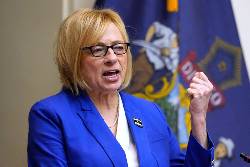
PORTLAND, Maine (AP) — Maine Gov. Janet Mills on Thursday dropped her bid for the U.S. Senate just weeks before the Democratic primary in a race that reflected an internal party debate over how to win one of this year's most competitive Senate seats.
“While I have the drive and passion, commitment and experience, and above all else – the fight – to continue on, I very simply do not have the one thing that political campaigns unfortunately require today: the financial resources," Mills said in a statement. “That is why today I have made the incredibly difficult decision to suspend my campaign for the United States Senate.”
Mills, a two-term governor and longtime Maine politician, was seen as one of Democrats' top 2026 recruits when she entered the Senate race last year. She had the backing of Senate Minority Leader Chuck Schumer and prominent left-leaning advocacy groups hoping to unseat Republican Sen. Susan Collins and help the party win control of the closely divided Senate.
But Mills struggled to outshine first-time candidate Graham Platner, her opponent in the June 9 Democratic primary. Platner has maintained strong popularity despite facing controversy over past comments he made online and a tattoo he had that is widely recognized as a Nazi symbol.
Mills did not endorse Platner in her campaign suspension announcement but instead promised to keep defending the Constitution and democracy while she's governor for the remainder of her term.
Meanwhile, Schumer and Democratic Senatorial Campaign Committee Chair Sen. Kirsten Gillibrand, both of New York, said they would work with Platner to defeat Collins.
“Our North Star is winning a Democratic Senate majority, and over the past year, Senate Democrats have carved out multiple paths to do that,” their statement said.
The contest between Platner and Mills was part of a broader debate within the Democratic Party over how best to defeat Republicans and win back some power in President Donald Trump's Washington, where the GOP controls the White House and both chambers of Congress.
Platner is backed by Vermont Sen. Bernie Sanders, an independent who caucuses with Democrats, and Democratic Sens. Elizabeth Warren of Massachusetts, Ruben Gallego of Arizona and Martin Heinrich of New Mexico.
Mills had tried to convince voters that she was the best candidate to stand up to Trump, repeatedly noting she told the president she would see him in court, a reference to Maine officials' lawsuit against the Trump administration over federal funding and a dispute over transgender athletes in sports.
Yet the message appeared at times drowned out by the popularity Platner attracted on the campaign trail. His events have attracted thousands of supporters as he pitched his populist message and flooded airwaves with his ads. He consistently outraised Mills every step of the way, raising $4 million while Mills raised $2.6 million in the latest fundraising quarter. Collins raised $3.1 million but has $10 million in the bank.
Age also became an issue in the race, as some Democrats want younger candidates to lead the party going forward. Mills is 78, while Plater is 41. Collins is 73.
So far this year, Democrats have largely avoided messy internal fights in their bid to retake the Senate. The Maine race was an exception, and with Mills’ decision, the Michigan Democratic primary could be the most heated campaign this year. Abdul El-Sayed, U.S. Rep. Haley Stevens and state Sen. Mallory McMorrow are locked in a competitive race there ahead of the August primary.
Many political observers initially anticipated that it would be Platner, not Mills, who would be forced to bow out of the race.
Platner has been dogged by questions about the skull-and-crossbones tattoo recognized as a Nazi symbol that he said he got on his chest during a night of drinking while on military leave in Croatia. He has said the tattoo has been covered to no longer reflect that image. Additionally, there have been lingering questions about inflammatory comments he made in old online postings, which he has since disavowed.
Yet, Platner's willingness to talk about his past mistakes has helped propel his favorability.
___
Kruesi reported from Providence. R.I. Associated Press writer Steven Sloan contributed from Washington.
___
Follow the AP’s coverage of the 2026 election at https://apnews.com/projects/elections-2026/.
...