


DUBAI, United Arab Emirates (AP) — Israel’s military said Yemen had launched a missile toward Israel early Saturday morning, the first time it had faced fire from that country.
Sirens went off around Beer Sheba and the area near Israel’s main nuclear research center for the third time overnight Friday into Saturday as Iran and Hezbollah continued to fire on Israel overnight.
The Houthis, a rebel group backed by Tehran, have held Yemen’s capital, Sanaa, since 2014. They did not immediately acknowledge launching an attack against Israel.
The Houthis so far had stayed out of the war as the rebels have had an uneasy ceasefire for years with Saudi Arabia, which launched a war against the group on behalf of Yemen’s exiled government in 2015.
Attacks on vessels during the Israel-Hamas war upended shipping in the Red Sea, through which about $1 trillion worth of goods passed each year before the war. The rebels also fired drones at Israel.
Israel struck Iran’s nuclear facilities hours after threatening to “escalate and expand” its campaign against Tehran on Friday. Iran vowed to retaliate and struck a base in Saudi Arabia, wounding U.S. service members and damaging planes.
On Friday, Brig. Gen. Yahya Saree, a military spokesman for the Houthis, issued a prerecorded statement outlining several ways the rebels could join the war on behalf of Iran.
“We affirm that our fingers are on the trigger for direct military intervention in any of the following cases,” Saree said. They included the “continuation of the escalation against the Islamic Republic and the Axis of Jihad and Resistance, as dictated by the theatre of military operations.”
In 2024, the Trump administration launched strikes against the Houthis that ended weeks later. The U.S.-led campaign against the Houthi rebels, overshadowed by the Israel-Hamas war in the Gaza Strip, turned into the most intense running sea battle the Navy had faced since World War II
The possible entrance of the Houthis into the war also called into question whether the rebels will again targeted commercial shipping traveling through the Red Sea corridor. The Houthi rebels attacked over 100 merchant vessels with missiles and drones, sinking two vessels and killing four sailors, from November 2023 until January 2025.
That would cause further chaos in global shipping, which already is reeling from Iran’s stranglehold over the Strait of Hormuz, the narrow mouth of the Persian Gulf through which a fifth of all oil and natural gas once passed.
Prior to the attack from Yemen, there appeared to be a breakthrough as Tehran agreed to allow humanitarian aid and agricultural shipments through the Strait of Hormuz, accepting a request from the U.N. Ali Bahreini, the country's ambassador to the United Nations in Geneva, said Iran agreed to “facilitate and expedite” such movement.
The vital waterway usually handles a fifth of the world’s oil shipments and nearly a third of the world’s fertilizer trade. While markets and governments have largely focused on blocked supplies of oil and natural gas, the restriction of fertilizer ingredients and trade threatens farming and food security around the world.
“This measure reflects Iran’s continued commitment to supporting humanitarian efforts and ensuring that essential aid reaches those in need without delay,” Bahreini said on the social platform X. The U.N. earlier announced a task force to address the ripple effects that the war has had on aid delivery.
The Iranian attack on Prince Sultan Air Base wounded at least 10 American troops, according to two U.S. officials familiar with the situation. Two of them were seriously hurt, according to one of the officials. Both of the officials spoke on condition of anonymity to discuss sensitive military matters. Several refueling aircraft were damaged.
Israel strikes Iranian nuclear facilities
Bahreini's announcement came just hours after Iranian state media said two nuclear facilities had come under attack. Israel, which had threatened to “escalate and expand” its campaign against Tehran, claimed responsibility, and Iran quickly threatened to retaliate.
“Iran will exact HEAVY price for Israeli crimes,” Iranian Foreign Minister Abbas Araghchi said via X.
Iran’s Atomic Energy Organization said the Shahid Khondab Heavy Water Complex in Arak and the Ardakan yellowcake production plant in Yazd Province were targeted, IRNA reported. The strikes did not cause any casualties and there was no risk of contamination, it said. The Arak plant has not been operational since Israel attacked it last June.
Yellowcake is a concentrated form of uranium after impurities are removed from the raw ore. Heavy water is used as a moderator in nuclear reactors.
The Israeli military later said raw materials are processed for enrichment at the Yazd plant and the strike was a major blow to Iran's nuclear program.
Seyed Majid Moosavi, IRGC’s Aerospace Force commander, said on X that employees of companies tied to the U.S. and Israel should abandon their workplaces: “This time, the equation will no longer be ‘an eye for an eye,’ just wait.”
Late Friday, Israeli authorities said Iran had launched missiles at the country that killed a 52-year-old man in Tel Aviv. Sirens alerted people to seek shelter in and around Tel Aviv, Jerusalem, Beer Sheba and areas near the country's main nuclear research center, which were targeted by Iranian strikes that injured dozens last weekend.
Trump renews call for Israeli-Saudi ties
Speaking in Miami at an event sponsored by the Saudi sovereign wealth fund, Trump reiterated his desire for those two countries to normalize relations.
The president has been pressing the two biggest powers in the Middle East on that for years as part of his Abraham Accords efforts, and he said the time will be right when hostilities end with Iran.
“It’s now time,” he said. “We’ve now taken them out, and they are out bigly. We got to get into the Abraham Accords.”
Significant headwinds remain, including Saudi Arabia’s insistence that there needs to be a credible path to a Palestinian state before it normalizes commercial and diplomatic ties with Israel.
US pushes diplomatic solution
Word of the attacks on Iran came after Trump claimed that talks on ending the war were going “very well” and that he had given Tehran more time to reopen the Strait of Hormuz. Iran maintains that it has not engaged in any negotiations.
With stock markets reeling and economic fallout from the war extending far beyond the Middle East, Trump is under growing pressure to end Iran's chokehold on the strait.
A Gulf Arab bloc said Thursday that Iran has been exacting tolls from ships to ensure safe passage.
Trump envoy Steve Witkoff said Washington delivered a 15-point “action list” to Iran for a possible ceasefire, using Pakistan as an intermediary. It proposes restricting Iran’s nuclear program and reopening the strait.
Iran rejected the offer and presented its own five-point proposal that included reparations and recognition of its sovereignty over the waterway.
Trump has said if that Iran doesn't reopen the strait to all traffic by April 6, he will order the destruction of Iran’s energy plants.
Uncertainty surrounding the conflict prompted a further drop in U.S. stocks Friday. The S&P 500 sank 1.7% to close out its worst week since the Iran war started and its 5th losing week in a row. The Dow Jones Industrial Average dropped 1.7%, and the Nasdaq composite sank 2.1%. Meanwhile, crude oil prices continued to soar.
With U.S. gas prices approaching $4 a gallon, members of Congress have been pushing to suspend the federal gasoline tax, set at 18.4 cents per gallon on gasoline and 24.4 cents per gallon on diesel fuel. Trump said he has “thought about” suspending it but suggested states should look at suspending their taxes on fuel.
Attacks appear to intensify early Saturday
Witnesses in eastern Tehran reported a partial power outage following airstrikes. In Israel, loud explosions filled the air in Tel Aviv and emergency crews responded to nearly a dozen impact sites.
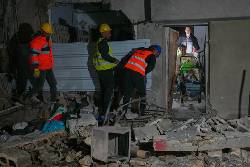
An Associated Press journalist heard loud explosions in Tel Aviv, and Israel’s Fire and Rescue Service said it was responding to 11 different impact sites across the metro area.
Defense Minister Israel Katz had earlier vowed that Iran “will pay heavy, increasing prices for this war crime.”
Israel focused its attacks Friday on sites “in the heart of Tehran” where ballistic missiles and other weapons are produced, the military said. It said it also hit missile launchers and storage sites in Western Iran.
Saudi Arabia's Defense Ministry, meanwhile, said it shot down missiles and drones targeting the capital, Riyadh. In Lebanon, the Health Ministry said two people were killed.
Kuwait said its Shuwaikh Port in Kuwait City and the Mubarak Al Kabeer Port to the north, which is under construction as part of China’s “Belt and Road” initiative, sustained “material damage” in attacks. It appeared to be one of the first times a Chinese-affiliated project in the Gulf Arab states has come under assault in the war. China has continued to purchase Iranian crude.
Diplomatic wrangling endures even as US sends more troops
Diplomats from several countries including Pakistan and Turkey have tried to organize a direct meeting between U.S. and Iranian envoys. Separately, G7 foreign ministers meeting Friday in France formally asked for an immediate halt to attacks against populations and infrastructure.
Meanwhile, U.S. ships drew closer to the region carrying some 2,500 Marines, and at least 1,000 paratroopers from the 82nd Airborne — trained to land in hostile territory to secure key positions and airfields — have been ordered to the Middle East.
Nevertheless, Secretary of State Marco Rubio said the U.S. “can achieve all of our objectives without ground troops.” Rubio, speaking to reporters following the G7 meeting, said the deployments are designed to ensure “maximum opportunity to adjust to contingencies should they emerge.”
Israel sent the 162nd Division into southern Lebanon to support efforts to protect its northern border towns from Hezbollah attacks and uproot the militant group, the military said.
The U.N.'s International Organization for Migration said Friday that 82,000 civilian buildings in Iran, including hospitals and the homes of 180,000 people, are damaged.
“If this war continues, we risk a far wider humanitarian disaster,” Jan Egeland, secretary general of the Norwegian Refugee Council, said in a statement. “Millions could be forced to flee across borders, placing immense pressure on an already overstretched region.”
Death toll climbs, primarily in Iran and Lebanon
Nineteen people have died in Israel, while four Israeli soldiers have been killed in Lebanon.
Authorities said more than 1,100 people have been killed in Lebanon, and over 1,900 people in Iran.
At least 13 American troops have been killed, and four people in the occupied West Bank and 20 in Gulf Arab states have also died.
In Iraq, where Iranian-supported militia groups have entered the conflict, 80 members of the security forces have died.
___
Amiri reported from New York, and Toropin from Washington. Associated Press writers Giovanna Dell'Orto in Miami; Fay Abuelgasim in Cairo; Sam Mednick in Tel Aviv, Israel; Fatma Khaled in Cairo; Sam McNeil in Brussels; Matthew Lee in Paris; Matthew Daly Washington; and Edith M. Lederer at the United Nations contributed.
...