


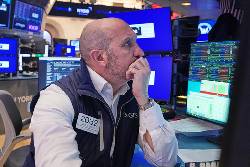
NEW YORK (AP) — U.S. stocks and oil prices flip-flopped Tuesday as uncertainty rose about what will happen following a ceasefire in the war with Iran, which had been set to expire Wednesday.
The S&P 500 erased an early rise to fall 0.6% after U.S. Vice President JD Vance called off a trip to Pakistan, where he was expected to lead U.S. negotiators in talks with Iran to extend the ceasefire.
The Dow Jones Industrial Average dropped 293 points, or 0.6%, after erasing an earlier gain of 400 points, while the Nasdaq composite slipped 0.6%. Less than 10 minutes after the U.S. stock market finished trading for the day President Donald Trump said he would extend the ceasefire to give Iran time to submit a proposal to end the war.
Oil prices also wavered before Trump announced the extension, and the price for a barrel of Brent crude went from less than $95 to roughly $100 during the day. It settled at $98.48, up 3.1%.
The moves were mostly more modest than the vicious swings that rocked Wall Street earlier in the war, when the price for a barrel of Brent crude briefly topped $119 and the S&P 500 dropped nearly 10% below its prior all-time high. The U.S. stock market remains near its most recent record, which was set Friday, indicating optimism still remains in financial markets that the United States and Iran will avoid a worst-case scenario for the economy.
“It’s become cliched to say that the economic hit will depend on the duration of the Middle East conflict, but that cliché does ring true,” according to Brian Jacobsen, chief economic strategist at Annex Wealth Management.
Much of the tension in financial markets has focused on what will happen to the Strait of Hormuz, a narrow waterway off Iran’s coast that oil tankers use to exit the Persian Gulf. A long-term closure would keep crude oil pent up in the gulf and away from customers worldwide.
Helping to limit Wall Street’s losses were UnitedHealth Group and other big companies that reported bigger profits for the latest quarter than analysts expected.
UnitedHealth jumped 7% after also raising its forecast for profit over the full year of 2026. That’s big because stock prices tend to follow the path of corporate profits over the long term, and it’s a double-plus when companies not only top earnings estimates but also forecast better growth ahead.
Quest Diagnostics rose 4.4% after likewise reporting fatter profit for the latest quarter than analysts expected while also raising its profit forecast for the full year.
Amazon added 0.7% after Anthropic said it signed a new agreement and is committing more than $100 billion over the next 10 years to AWS technologies to train and run its Claude chatbot.
But they were all nevertheless overshadowed by a 2.5% drop for Apple, which was the day’s heaviest weight on the S&P 500. It fell in its first trading after Tim Cook said he’ll step down as CEO on Sept. 1 and become the iPhone maker’s executive chairman.
Cook is handing control over to John Ternus, a company veteran who rose through Apple’s hardware engineering ranks.
Tractor Supply, meanwhile, dropped 11.7% after reporting profit and revenue for the latest quarter that fell short of expectations.
All told, the S&P 500 fell 45.13 points to 7,064.01. The Dow Jones Industrial Average dropped 293.18 to 49,149.38, and the Nasdaq composite sank 144.43 to 24,259.96.
In stock markets abroad, indexes fell in Europe following a stronger finish in Asia. South Korea’s Kospi rallied 2.7% for one of the world’s biggest moves.
In the bond market, Treasury yields rose after a report on Tuesday morning showed that U.S. retailers made more money in March, the first full month of the war, than analysts expected. Growth was even relatively stable for retail sales when not including those from gasoline stations.
The yield on the 10-year Treasury climbed to 4.31% from 4.26% late Monday, and the gains accelerated late in the day with oil prices.
Kevin Warsh, Trump’s nominee to chair the Federal Reserve, said that he never promised Trump he would cut interest rates, even though Trump has angrily been calling for the central bank to do so. Warsh is facing a tightrope walk as U.S. senators consider his nomination because investors want him to maintain the Fed’s independence from political meddling.
___
AP Business Writers Matt Ott and Elaine Kurtenbach contributed to this report.
...