


U.S. President Donald Trump said he has demanded about seven countries send warships to keep the Strait of Hormuz open as Iranian strikes kept slamming into Gulf countries Monday.
Trump has said the U.S. is negotiating with countries heavily reliant on Middle East crude to join a coalition to police the waterway where about one-fifth the world’s traded oil normally flows. But European countries demanded to know when the conflict might end as they weighed whether to agree to his call to send warships for that effort.
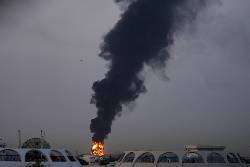
Also Monday, the U.S. and Israel pummeled military targets in Iran’s capital, Israel stepped up its campaign against Iran-backed militants in Lebanon and Iran retaliated with a drone strike that caused no injuries but temporarily forced the closure of Dubai’s airport, a crucial travel hub. The strike on a fuel tank started a fire that was quickly contained.
Tehran, meanwhile, accused the U.S. without evidence of using “ports, docks and hideouts” in the United Arab Emirates to launch strikes on Kharg Island, home to the main terminal handling Iran’s oil exports evidence Brent crude oil was trading near $105 per barrel Monday.
Here is the latest:
Israel approves new battle plans for continued ground operation in Lebanon
The military’s chief of staff, Lt. Gen. Eyal Zamir, said the Isareli army is “determined to deepen the operation until all of our objectives are achieved.”
Speaking on a visit to the northern border, Zamir said “We are preparing for what comes next and reinforcing the Northern Command with additional troops in order to strengthen the forward defensive posture, deepen the damage to Hezbollah, and push the threat away from the communities in the north.”
The army said in a statement that Zamir approved plans for “continued limited, targeted operations.”
A military spokesman said earlier on Monday that the army had deployed additional ground troops into Lebanon for what it calls a “limited and targeted operation.”
Economic conditions are getting hard for Iranians amid war
A Tehran resident said workers paid by the day were struggling especially hard because of the war. The internet blackout also has hammered businesses that normally rely on online sales.
“Money has become scarce, people cannot buy things, and businesses are being damaged,” the resident said, speaking on condition of anonymity for fear of reprisals from the government.
The streets were busier than at the beginning of the war, he said, because people were growing desperate and needed to earn money.
Stores still had food. Fuel was not in short supply. Utilities were still functioning. And people could still withdraw money from banks, he said. But he said people were deeply anxious as the attacks persisted.
Even before the war, Iran’s economy had been crippled by international sanctions.
EU considers immediate steps to ease energy costs amid the Iran war
As the Iran war sends energy costs higher across the 27-nation European Union, Energy Commissioner Dan Jørgensen said EU energy ministers met Monday in Brussels to discuss targeted, temporary steps to lower bills for businesses and vulnerable households.
Over the longer term, he said the EU will double down on clean energy and domestic production to reduce reliance on volatile global markets, referencing the EU’s push to cut dependence on Russian energy after Moscow’s 2022 invasion of Ukraine.
“Now Europe faces again an existential choice: Stay dependent on volatile global energy markets, or finally take control of our own energy future,” he said.
About 200 US troops wounded since start of the Iran war, military says
About 200 U.S. troups have been wounded since the start of the Iran war though more than 180 service members have returned to duty, Capt. Tim Hawkins, the spokesman for U.S. Central Command, told The Associated Press.
Hawkins said 10 service members are considered seriously wounded.
The previous update released last week by the Pentagon put the number of wounded personnel at around 140 and eight as “severely injured.”
CENTCOM has not said when or where those troops were wounded, or given details on the type of injuries.
Since the war in Iran began, 13 U.S. service members have been killed.
An airstrike turns a police station in a Tehran neighborhood to dust
A resident of Tehran was driving Monday when an airstrike destroyed a police station in the Iranian capital and heavily damaged neighborhood shops nearby. It appeared the police station had been abandoned days ago.
“The blast was so strong it shook our eardrums. The cars in front of me were almost completely destroyed," the resident said, speaking on condition of anonymity for fear of reprisals from the government.
He quickly drove in reverse to get away. Others abandoned their cars, he said.
The government sealed off the area and detained anyone trying to photograph it.
“The situation felt like the end of the world,” he said.
A drone attack targets an oil field in southern Iraq
Two Iraqi security officials said that the Majnoon oil field in Iraq's southern Basra province was targeted by two drones Monday.
No casualties were reported, and it was not immediately clear if there was damage to the facilities.
Iraq’s oil industry has been severely impacted by the American-Israeli war with Iran and the closure of the Strait of Hormuz, a vital oil trading corridor.
Another security official said that air defenses shot down a drone that attempted to target a U.S. logistics support center near the Baghdad airport. The officials spoke on condition of anonymity because they were not authorized to comment publicly.
Iran and Iran-backed Iraqi militias have launched dozens of attacks against U.S. facilities in Iraq since the beginning of the war.
United Nations peacekeepers see Israeli buildup in southern Lebanon
There’s an “evident” buildup of Israeli troops inside Lebanese territory in at least six locations near the Blue Line, the border with Israel, said the U.N. peacekeeping force spokesperson Kandice Ardiel.
UNIFIL peacekeepers have also seen clashes around the villages of Odaisseh and Khiam in the region. In some cases, she said, Israeli ground incursions reached at least 5 kilometers (3 miles) into Lebanese territory, although forces have not established permanent positions that deep.
The Israeli military has said it is moving more troops into Lebanon as it attempts to push Hezbollah away from the border but has not given numbers.
U.N. peacekeepers have not been able to move around or monitor the situation fully because of the current fighting, Ardiel noted.
Strike in Iraq kills 6 fighters with a force that once fought the Islamic State group
Iraq’s Popular Mobilization Forces said Monday that one of its checkpoints in Anbar province was hit and another four fighters were also wounded in addition to the six killed.
The PMF is a network of mostly Shiite, Iran-backed militias formed to fight the Islamic State group after extremists seized large parts of Iraq in 2014. Baghdad incorporated the PMF into its armed forces in 2016.
In practice, some factions have continued to operate outside state control and have attacked U.S. troops during the current American-Israeli war with Iran.
There was no immediate comment from the U.S. or Israel on the strike.
Germany’s Merz warns Israel that a ground offensive in Lebanon could spur an ‘exodus of refugees’
Speaking in Berlin, the German chancellor condemned Hezbollah for entering the conflict “on behalf of Iran” and called on the Lebanese militant group to stop attacking Israel and to disarm.
At the same time, he urged Israel to avoid attacking civilians in Lebanon and said a wider ground war “would further exacerbate the already highly tense humanitarian situation.”
“We therefore urge our Israeli friends: Do not take this path,” Merz said of a broader ground offensive. “It would be a mistake.”
Germany’s Merz says Iran war can only end with a political solution
“Bombing it into submission is, in all likelihood, not the right approach,” to creating a democratic government in Iran, German Chancellor Friedrich Merz said. “There will be no military solution here.”
Responding to Trump’s calls to send warships to police the Strait of Hormuz, Merz said “NATO is a defensive alliance, not an interventionist one.” Mertz spoke Monday after meeting with the Dutch prime minister.
NATO troops deployed for 18 years to Afghanistan and its 2011 air campaign helped topple Libya’s late leader Moammar Gadhafi.
Jerusalem’s Old City area is hit by shrapnel from an Iranian missile interception
There were no reports of injuries after chunks of twisted metal smashed into areas of Israeli-annexed east Jerusalem, including the Old City.
Shrapnel hit the rooftop of the Greek Orthodox Patriarchate in Jerusalem, according to the Patriarchate, just meters from the Church of the Holy Sepulcher, where many Christians believe Jesus was crucified and rose from the dead.
Israel’s Fire and Rescue service said a large piece from an intercepted missile struck a home in east Jerusalem’s Silwan neighborhood, which is adjacent to the Old City walls.
Another large fragment landed in the yard of a home in Sheikh Jarrah, just north of the Old City, according to the Jerusalem Governate. Both are predominantly Palestinian neighborhoods.
Although wartime damage to the Old City is relatively rare, it contains sites that are sacred to Jews, Muslims and Christians, meaning any hits or near-misses sharpen the conflict’s stakes.
Trump says he’s frustrated about a lack of ‘enthusiasm’ from other countries to join in policing the Strait of Hormuz
The president said at an event at the White House on Monday that “numerous countries” have told him “they’re on the way” to help police the strait but he complained about their reluctance.
“The level of enthusiasm of enthusiasm matters to me,” he said.
He seemed to suggest their hesitancy showed a lack of reciprocity by countries that have defense agreements with the U.S.
“I know that we’ll protect them and if ever needed, if we ever needed help, they won’t be there for us,” he said.
Egypt’s top diplomat is visiting regional allies
To reiterate Cairo’s support for nations impacted by Iranian air attacks, Egypt’s Foreign Minister Badr Abdelatty on Monday concluded a round of visits to Oman, Qatar, Jordan, the United Arab Emirates and Saudi Arabia.
His talks in Riyadh are expected to discuss de-escalation efforts and “creating a coordinated Arab move to protect sovereignty and resources of Arab countries,” according to a Foreign Ministry statement.
A new statement is issued in the name of Iran’s new supreme leader amid reports he was wounded in an airstrike
Ayatollah Mojtaba Khamenei said all those previously appointed to government positions by his father, the late Ayatollah Ali Khamenei, will remain in their posts.
Mojtaba Khamenei has not been seen in public since he was chosen to replace his father, who was killed in the initial wave of U.S.-Israeli airstrikes on Iran. Mojtaba Khamenei’s statement Monday was carried on several semiofficial news sites.
The death toll in Lebanon from Israeli strikes increases to 886
That’s up from 850 killed as of Sunday, according to Lebanon’s Health Ministry.
On Monday, the ministry said the death toll includes at least 111 children and 67 women. The number of wounded has climbed to 2,141 people, including 332 children and 362 women.
The latest round of fighting between Israel and Hezbollah began on March 2. Israel says it is striking Hezbollah militants and infrastructure.
The Israeli strikes have mostly been in southern and eastern Lebanon as well as parts of Beirut, and have targeted buildings, vehicles and even tents for internally displaced people.
More than 800,000 people — nearly one out of every seven residents of Lebanon — have been displaced after Israel ordered people to evacuate large swathes of the country.
Israeli ambassador doesn’t rule out sending navy to police Strait of Hormuz but says it should be a global effort
A day after Trump demanded other countries to join a coalition to police the Strait of Hormuz, Israel’s envoy to the U.N. tried to make the case that the burden shouldn’t be just on America’s closest ally in the region.
“We understand the need to support the effort of the U.S. and it should be a global effort,” Danny Danon said. “You look at Israel, a tiny country and you know Iran is I think 80 times bigger than Israel and we take a lot of the burden for the world.”
Israeli ambassador says ‘a few players’ are trying to mediate talks with Lebanon
Israel’s U.N. ambassador Danny Danon told reporters Monday that a few countries are trying to mediate and host talks between Israel and Lebanon but that his country is determined to “degrade” Hezbollah’s capabilities before any negotiations can take place.
“Our message to the Lebanese government is simple: step up. Step in,” Danon said. “Since the ceasefire in November 2024, the Lebanese government has not done what it needed to do to dismantle Hezbollah.”
He added, “Lebanon must restrain Hezbollah now, or we will.”
IEA says emergency oil stocks could be tapped again if needed
The 32 member countries of the International Energy Agency could release more oil from emergency stockpiles if necessary, on top of 400 million barrels announced last week. That was the message Monday from IEA Executive Director Fatih Birol.
Birol said last week’s release was a “buffer for now” that had helped restrain the increase in oil prices. But he added there are “a lot of stocks left despite this huge release.”
That means “we can do more later, as and if needed.”
Birol says members have a further 1.4 billion barrels in reserves or industry stocks that governments could access.
The IEA head says the single most important factor for a return to stable flows of oil and gas would be a resumption of tanker traffic through the Strait of Hormuz.
Before the Iran war, the global economy consumed about 101 million barrels of oil a day. Brent crude is trading at over $100 a barrel.
Shrapnel from Iranian missile barrage falls near the Church of the Holy Sepulchre in Jerusalem
Shrapnel from an interception fell on the rooftop of the Greek Orthodox Patriarchate in Jerusalem, according to the Patriarchate. That’s just meters from the Church of the Holy Sepulchre, built on the spot where Christian tradition holds that Jesus was crucified, buried and resurrected.
There were no immediate reports of injuries from the impact.
Jerusalem’s Old City, where there are holy sites sacred to Muslims, Christians, and Jews, has come under uncommon fire this war. In past missile exchanges with Iran — including the 12-day-war — the city had been spared the damage seen in nearby cities like Tel Aviv or Beersheba.
But since the start of the most recent war, shrapnel has struck multiple sites close to the Old City, including homes in east Jerusalem, a main highway into Jerusalem and a concert venue in West Jerusalem.
Falling oil prices send stocks higher
Oil prices are down, and stocks are up Monday, though such moves have been quick to change since the war in Iran began.
The S&P 500 rose 1% in early trading, coming off its third straight losing week, its longest such streak in a year. The Dow Jones Industrial Average was up 325 points, or 0.7%, as of 9:35 a.m. Eastern time, and the Nasdaq composite was 1.2% higher.
The driver for markets once again was the price of oil. A barrel of benchmark U.S. crude fell 4.1% to $94.62, easing some pressure off the economy after topping $102 earlier in the morning. Brent crude, the international standard, fell 1.4% to $101.72 per barrel after earlier getting as high as $106.50.
Oil prices have been mostly ripping higher from roughly $70 per barrel since the United States and Israel began their attacks on Iran.
▶ Read more
Lebanon’s foreign ministry criticizes Hezbollah over shooting at UN peacekeepers
In a Monday statement, the ministry recalled the government’s decision which prohibits “the military and security activities of Hezbollah.”
It added that the ministry’s position in the matter is clear in which “no armed group operating outside the authority of the state” will be permitted to draw Lebanon further into instability in service of agendas that run counter to Lebanon’s national interests.
The ministry was apparently referring to Iran, Hezbollah’s main backer.
The U.N. peacekeeping force in Lebanon known as UNIFIL said Sunday that peacekeepers were fired upon, “likely by non-state armed groups” on three separate occasions while conducting patrols around their bases in three villages in southern Lebanon.
The U.N. peacekeeping force did not say Hezbollah was behind the attacks.
Genesis Prize doubles award to actor Gal Gadot
Israel’s Genesis Prize says it’s doubling the prize it’s awarded to Israeli actor Gal Gadot to $2 million to promote healing and resilience in Israel.
The “Wonder Woman” star was named this year’s laureate in November for her support of Israel. She dedicated the $1 million prize to organizations that “help Israel heal” after more than two years of war.
The Genesis Prize, along with the Jewish Funders Network, a group of philanthropic leaders, said Monday they were doubling that gift with matching funds.
“At a time when Israel’s caregivers are stretched beyond capacity, we must ensure that those who are helping others heal receive the support they need,” Andres Spokoiny, president and chief executive of the network, said in a statement.
The prize is granted each year to a person for their professional achievements, contributions to humanity and commitment to Jewish values.
White House press secretary Karoline Leavitt says China trip could be postponed
Leavitt says “leader-to-leader” talks between Trump and Chinese President Xi Jinping are happening and that “at this point,” Trump looks forward to visiting China.
But those dates “may be moved,” she said.
“As commander-in-chief, it’s his number one priority right now to ensure the continued success of this Operation Epic Fury,” Leavitt told reporters at the White House on Monday morning.
US Treasury Secretary Scott Bessent downplays oil price surge
The treasury secretary followed Trump’s lead Monday and dismissed concerns about rising oil prices since the start of the Iran war.
Bessent accused the media of “trying to make it into some crisis that it’s not,” and he insisted prices would come down after the conflict ends.
“I don’t know how many weeks it will be, but on the other side of this, the world will be safer, and we will be better supplied,” Bessent said on CNBC.
He said the Treasury Department hasn’t traded oil futures to try to cap prices. Asked whether it would going forward, the secretary said: “I’m not sure under what authority or what auspices” that would happen.
Trump’s Interior Secretary Doug Burgum told Bloomberg Television over the weekend that the administration has talked about that strategy.
UAE reports attacks by 6 missiles and 21 drones
The United Arab Emirates was attacked Monday with six ballistic missiles and 21 drones coming from Iran. That’s according to the Emirati Defence Ministry.
The ministry tallied 304 ballistic missiles, 15 cruise missiles and 1,627 drones since the start of the war.
The attacks killed seven people including two troops, it said.
British Prime Minister Keir Starmer defends decision to differ with Trump
Starmer has defended resisting Trump’s pressure for the U.K. to join the war against Iran, saying he has “stood by my principles.”
Trump has berated the British leader for limiting the use of U.K. bases by American warplanes and declining to send an aircraft carrier to the Middle East. Trump complained to the Financial Times that “when I asked for them to come, they didn’t want to come.”
Starmer said at a news conference Monday that British troops should only be sent into action that is legal and has “a proper thought-through plan.”
Iraq’s oil minister says new route for oil exports set to open
Iraqi Oil Minister Hayan Abdul-Ghani said Monday in a video statement that a pipeline from the northern city of Kirkuk to Turkey will be operational within a week, allowing the country to resume oil exports interrupted by the ongoing regional war.
Iraq previously exported around 3.4 million barrels of oil a day through its southern port of Basra, he said, but “in light of the military operations and the closure of the Strait of Hormuz, Iraqi oil exports stopped two or three days after the beginning of the war in the region.”
Abdul-Ghani said the pipeline from Kirkuk to Turkey, with a capacity of 200,000 to 250,000 barrels a day, is currently undergoing hydrostatic testing. The route will bypass the semiautonomous Kurdish area in northern Iraq after Baghdad could not reach an agreement with local authorities over conditions for exporting via another pipeline in the Kurdish region.
Israel says displaced Lebanese will have to wait to return home
Israeli Defense Minister Israel Katz said those that fled southern Lebanon in the face of Israeli fighting against Hezbollah militants won’t be able to return home until northern Israel, which has been hit by barrages of rockets, is safe.
“Hezbollah will pay a heavy price for its aggression and activity in the Iranian axis to destroy Israel,” he said.
“We have promised security to the residents of the north, and that is exactly what we will do,” he said.
American efforts to protect Strait of Hormuz continue, US military commander says
The top U.S. military commander in the Middle East says American forces are zeroing in on Iran’s threats to freighters carrying oil and natural gas through a vital chokepoint in the Persian Gulf.
“We will continue to rapidly deplete Iran’s ability to threaten freedom of navigation in and around the Strait of Hormuz,” Admiral Brad Cooper, the head of U.S. Central Command, said in a video posted to X on Monday.
Iranian strikes on commercial vessels have effectively stopped shipping traffic in the waterway, through which a fifth of the world’s oil is transported. That has dramatically increased the price of oil and put pressure on Washington to do something to ease the pain for consumers.
Trump says he may delay China trip as Iran war roils oil prices
Trump may delay his China trip due to the Iran war, but Treasury Secretary Scott Bessent said Monday it’s not to pressure Beijing on the Strait of Hormuz.
Bessent said any delay to Trump’s trip to Beijing wouldn’t be because of disagreements over the Iran war or efforts to reopen the Strait of Hormuz.
“If the meeting for some reason was rescheduled, it would be rescheduled because of logistics,” he said. “The president wants to remain in D.C. to coordinate the war and traveling abroad at a time like this may not be optimal.”
Trump has suggested he may delay the much-anticipated visit to China at the end of the month as he seeks to ramp up the pressure on Beijing to help reopen the Strait of Hormuz and calm oil prices that have soared during the Iran war.
▶ Read more
Italy signals reluctance to Trump’s call to help open Strait of Hormuz
Italy is the latest country to react cautiously to Trump’s demand that allies help open the Strait of Hormuz.
Italian Foreign Minister Antonio Tajani told reporters in Brussels on Monday that Italy backs reinforcing EU naval missions in the Red Sea.
But he added: “However, I don’t think these missions can be expanded to include the Strait of Hormuz, especially since they are anti-piracy and defensive missions.”
U.S. President Donald Trump said he has demanded about seven countries send warships to keep the Strait of Hormuz open, as Iranian strikes continued to rain down on Gulf countries.
A Pakistani oil tanker transited through Strait of Hormuz
A vessel tracker says a first tanker carrying non-Iranian oil has transited through the Strait of Hormuz.
The Pakistani-controlled tanker Karachi, which carries crude oil from Abu Dhabi, passed the strait on Sunday, according to data from MarineTraffic.
The tanker is now sailing in the Gulf of Oman, it said.
Starmer says UK seeks ‘viable’ plan to open Strait of Hormuz
Prime Minister Keir Starmer says Britain is working with allies on a plan to reopen the Strait of Hormuz, but “will not be drawn into the wider war.”
He spoke after U.S. President Trump said he’d demanded U.S. allies send warships to open the key oil shipment route.
Starmer said Britain is discussing with the U.S. and allies in Europe and the Gulf the possibility of using mine-hunting drones that the U.K. has in the region. But he signaled the U.K. is unlikely to dispatch a warship.
Trump has berated Starmer for a perceived lack of support for the war, after the prime minister initially refused to allow the U.S. to use British bases to strike Iran.
Starmer said at a news conference Monday that Britain is seeking “a viable collective plan” to reopen the strait, adding that it is, “to say the least, not easy.”
Iran says Strait of Hormuz is closed only to US, Israel and their allies
Iran’s top diplomat says the key Strait of Hormuz is only cut off for vessels of the United States, Israel and their allies.
“From our perspective it is open,” Foreign Minister Abbas Araghchi said of the strait. “It is only closed to our enemies, to those who carried out unjust aggression against our country and to their allies.”
Araghchi spoke at a news conference in Tehran on Monday.
...