


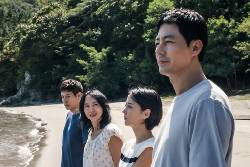
VENICE, Italy (AP) — There are some filmmakers who churn movies out like clockwork. And then there are others, like South Korean auteur Lee Chang-dong, who wait until they have something worthwhile to say. For movie lovers, it makes the arrival of his latest film “Possible Love,” now streaming on Netflix, something like an event.
His last film, “Burning,” a meditative thriller about three young people, was the first South Korean feature to be shortlisted for an Oscar, and was singled out by many critics as the best of 2018. And though South Korean cinema has soared at the Oscars since, Lee didn't feel rushed to get back in the mix as quickly as possible. This, he said, is not patience, exactly, but more of a pathological timidness.
“This is a big problem of mine,” the 72-year-old filmmaker told The Associated Press earlier this year, with the help of a translator. “With every film I do, I constantly ask myself, what meaning does this have? Is this a story worth telling?”
Lee was inspired by mass autoworker layoffs
This time, he found himself drawn to the story of mass layoffs in his home country. In 2009, the Ssangyong Motor Co. laid off about one-third of its workforce, which led to a high-profile confrontation between police and workers who occupied the company’s plant south of Seoul for more than two months. A spate of suicides among Ssangyong workers and family members also followed the automaker’s restructuring.
“I thought that that particular event not only was going to change the labor market of Korea, but also Korean society as a whole,” Lee said. “I thought that it was going to be, indeed, a significant turning point, and I thought it was going to fundamentally change not only the lives of those laid off workers, but also just everyday ordinary people’s lives as well.”
Others have taken on the effects of the mounting debt, unemployment and desperation in the country in fiction before, including the brutally violent “Squid Game," and Park Chan-wook's satirical “No Other Choice.”
Lee's approach wasn't going to be either of those, but he couldn’t run away from the nagging question of whether or not he was worthy to tell this story. Was there meaning, he wondered, in making it a dramatic film and not a documentary? Then, about two years ago, his cowriter Oh Jung-mi had a breakthrough: Why not connect this story with the story of a filmmaker trying to capture it? And suddenly, it started to make sense.
The story focuses on two couples, one wealthy, one not
But he’d been talking about it for so long that actor Jeon Do-yeon was a little suspicious when he reached out and asked if she wanted to be in the film. Jeon had starred in his 2007 drama “Secret Sunshine,” playing a young widow consumed by grief and anger after her son is murdered that would win her a best actress prize at the Cannes Film Festival.
“I’m personally such a big fan of his. I adore his films and I think his films are really precious,” Jeon said. “When he suggested that we work together on this film, we had been having discussions about it for about 10 years so I couldn’t actually really believe him … I kept asking for the script and only by reading the script would I truly believe that he was going to make this film.”
The script, she was happy to discover, was real, and her part was another special one: This time she would be playing Mi-ok, the optimistic spouse of a laid off autoworker, Ho-seok (Sul Kyung-gu). When a well-heeled documentary filmmaker Ye-ji ( “Parasite's” Cho Yeo-jeong ) approaches them about capturing their life and telling the story of laid off workers, she’s openhearted and eager to talk. Ho-seok, who is dealing with depression, is less open.
“She’s not able to get her husband the psychological help that she wants him to have in order for him to heal and recover, so she’s hoping by getting the help of the documentary filmmaker that he will get better in this way,” Jeon said.
Exploring two kinds of masculinity in South Korea
Mi-ok is also entranced by Ye-ji’s husband, Sang-woo (Zo In-sung), a handsome and wealthy businessperson who, at least on the surface, seems to be a kind of ideal. At one point, Mi-ok fawningly compares him to Steve Jobs. And while Ye-ji and Mi-ok might appear to be developing a friendship, the fact that it’s in service of a documentary makes it less pure.
Lee, though in part telling a story about himself telling a story, made his filmmaker character a woman. In South Korea, he said there are many female documentary filmmakers.
“I think they also have a stronger sense of empathy and great emotional intelligence,” he said. “I also wanted her husband to be representing that force, that power of wealth and capital.”
The film also provided a chance to talk about masculinity through two different characters. Ho-seok, Lee said, “embodies a masculinity that really belongs to the typical Korean male. He has a very heavy sense of responsibility for his family. He treats his co-workers as his brothers.”
When he’s laid off from his job and beaten by the police, his loss of identity is profound and intense.
“He finds himself feeling completely empty, that he has nothing to offer,” Lee said. “On the other hand, Sang-woo represents a new kind of masculinity, one that maybe belongs to the new era, I would say. He is very kind, very humane. He’s also very soft. He’s the ever-helpful husband to Ye-ji, he’s also a good listener. However, all of that with a very, very tightly masked sense of violence.”
‘Possible Love’ is a possible Oscar contender
“Possible Love” has been racking up accolades and acclaim since the Venice Film Festival, where it won the runner-up prize. South Korea has also selected it as its official submission for best international feature at the 99th Academy Awards.
But before the film’s premiere in Venice, Lee brushed off the suggestion that people are eagerly awaiting new films from him, saying he doesn’t think that people place that much interest in his work.
“He really said that?” Jeon asked later.
When I assure her that he did, she paused and smiled and switched, ever so briefly, to English for the first time in the interview: “Liar,” she said.
...