


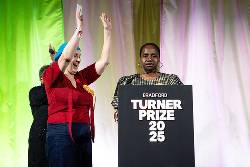
LONDON (AP) — Scottish artist Nnena Kalu has been awarded the Turner Prize for work that includes vivid abstract drawings and hanging sculptures, the first artist with a learning disability to win Britain’s most famous visual art award.
Kalu, 59, who has autism, received the 25,000-pound ($33,000) prize on Tuesday evening at a ceremony in Bradford, northern England.
Her winning works included a series of brightly colored cocoonlike shapes made of wrapped materials that hung amid the concrete pillars of a disused power station in Barcelona.
The judging panel led by Tate Britain director Alex Farquharson praised the “powerful presence” of her “bold and compelling” work.
Kalu, who has limited verbal communication, is a resident artist at ActionSpace’s studio, which supports learning disabled artists in London.
Charlotte Hollinshead of ActionSpace said Kalu had "made history.”
“This is a major, major moment for a lot of people. It’s seismic. It’s broken a very stubborn glass ceiling,” Hollinshead said onstage at the award ceremony in Bradford, the U.K.’s 2025 city of culture.
Kalu beat three other artists — Rene Matic, Mohammed Sami and Zadie Xa — to the prize, which was founded in 1984 and named for 19th-century landscape painter J.M.W. Turner.
Established to promote young British artists, and now open to U.K. artists of any age, the prize helped make stars of shark-pickling artist Damien Hirst, potter Grayson Perry, sculptor Anish Kapoor and filmmaker Steve McQueen.
But it has also been criticized for rewarding impenetrable conceptual work and often sparks debate about the value of modern art. Winners such as Hirst’s “Mother and Child Divided,” which consists of two cows, bisected and preserved in formaldehyde, and Martin Creed’s “Lights On and Off” -- a room with a light blinking on and off -– have drawn scorn from sections of the media.
...