


NEW YORK (AP) — It's a scenario seen every day: A reporter shouts a question out to a leader at an event. The leader either answers or ignores it. In China, though, Bloomberg TV journalist Annmarie Hordern was blocked from a key event by Chinese officials Thursday, apparently as retribution for having shouted a question in a way that the government considered rude.
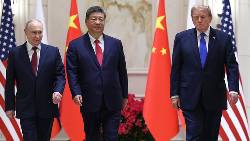
Hordern was barred from Thursday's trilateral meeting among President Donald Trump, Chinese leader Xi Jinping and Russian President Vladimir Putin in Shenzhen, China, after having called out a question during an Trump meeting with Xi. She had asked Trump if former Nvidia CEO Jensen Huang had been disloyal to the United States.
A White House official said the Chinese insisted the reporter not be allowed in despite the White House having pushed for admission. The official insisted on speaking on condition of anonymity because of the sensitivity around the issue.
The White House did not immediately respond to a query about what steps it took to advocate for the reporter. Jacqui Heinrich, president of the White House Correspondents' Association, said on X that it was “commendable that the WH is advocating for press access.”
A pool report from the incident said the Chinese “have passed along a message that yelling questions is considered extremely rude and we will be pulled from the room if we do so.”
China’s Foreign Ministry did not respond to a request for comment from The Associated Press, and an email to Bloomberg seeking comment was not immediately returned.
The incident, which reflected the way China typically seeks to tightly control news events, recalled a previous one in 2022, in which a White House pool reporter said she was knocked off balance after being yanked by her backpack when she tried to shout a question to President Joe Biden. The question was about human rights ahead of a meeting between Biden and Xi in Bali, Indonesia.
The reporter lost balance without falling and was pushed toward the door, a pool report said at the time. Two White House staff members intervened and said the producer should be left alone.
China's approach to journalists, particularly foreign media, has long been chilly and uneven. In recent decades, international reporters have been expelled both for their coverage and for perceived misbehavior during news events. Resident correspondents are occasionally detained and questioned — and in some cases in past years, compelled to sign “self-criticism” reports — for showing up where the government doesn't want them to be.
Chinese journalists who stray from the party line can face even more stringent measures, including censorship, dismissal and at times even imprisonment.
___
Associated Press reporter Michelle L. Price contributed from Shenzhen, China.
...